

Running a dental practice in 2026 means juggling patient care, staff coordination, and an avalanche of daily communications. But here’s the challenge most practices face: every text about an appointment, every email confirming treatment, and every phone call discussing insurance involves Protected Health Information (PHI).
One misstep with how you handle these communications can lead to hefty fines, legal headaches, and damaged patient trust. The good news? Modern HIPAA-compliant communication tools make staying secure easier than ever while actually improving how your practice runs.
Why Dental Practices Need HIPAA-Compliant Communication Tools
The way dental practices communicate has transformed dramatically over the past few years. Gone are the days when a simple phone call and paper forms were enough. Today’s patients expect text reminders, online scheduling, digital forms, and instant responses. This shift to digital communication is convenient, but it’s also opened the floodgates for potential HIPAA violations.
Here’s what’s driving the urgent need for compliant communication tools:
- Growing risks of PHI breaches: Cybercriminals increasingly target healthcare practices because patient data is valuable. A single unsecured text message or email can expose sensitive information and trigger a reportable breach.
- Increasing digital communication demands: Patients want to text their dentist like they text their friends. They expect to fill out forms online, receive appointment reminders via SMS, and even consult via secure messaging. Standard SMS, personal WhatsApp, and regular email simply aren’t built for this.
- Patient convenience meets compliance pressure: You need to meet patients where they are without cutting corners on security. Compliance isn’t optional—it’s the foundation of maintaining your practice’s reputation.
- Fines, lawsuits, and trust issues from non-compliance: HIPAA violations can cost anywhere from hundreds to millions of dollars depending on severity. Beyond fines, a breach destroys patient trust, something no marketing budget can rebuild.
What Makes a Communication Tool HIPAA-Compliant?
Not every software that claims to be “secure” meets HIPAA standards. Understanding what actually makes a tool compliant helps you evaluate vendors properly.
Encryption (in-transit and at-rest): This means patient data is scrambled both when it’s being sent (in-transit) and when it’s stored on servers (at-rest). Even if someone intercepts the data, they can’t read it without the encryption key.
Access controls and user permissions: Not everyone on your team needs access to all patient communications. HIPAA-compliant tools let you set role-based permissions so your front desk, hygienists, and dentists only see what’s relevant to their role.
Audit logs and activity tracking: These tools automatically track who accessed what information and when. If there’s ever a question about a potential breach, you have a complete record of all activity.
Secure storage and backups: Patient communications and data must be stored on secure servers with regular encrypted backups. If something goes wrong, you can recover information without compromising security.
Business Associate Agreement (BAA): This is the legal contract between your practice and the software vendor that makes them liable for protecting PHI according to HIPAA standards. If a vendor won’t sign a BAA, walk away—they’re not truly HIPAA-compliant.
Core Features to Look For in HIPAA-Compliant Dental Communication Tools
When evaluating communication platforms for your dental practice, certain features should be non-negotiable:
Two-way secure texting: Patients want to text, and your team needs to respond. Look for platforms that encrypt texts end-to-end and don’t rely on standard SMS networks.
Appointment reminders and confirmations: Automated reminders reduce no-shows dramatically. The system should send secure reminders via text, email, or app notifications with options for patients to confirm, reschedule, or cancel.
Digital patient forms: New patients should be able to complete medical history forms, consent documents, and insurance information online before they arrive. This saves front desk time and improves the patient experience.
Secure VoIP calling: Traditional phone lines have limitations. HIPAA-compliant VoIP systems let your team make and receive calls from anywhere while maintaining encryption and creating audit trails.
Encrypted email and internal chat: Your team discusses patient cases constantly. Internal messaging should be just as secure as external patient communication.
Patient records sharing with encryption: Sometimes you need to send X-rays to a specialist or share treatment plans with patients. The tool should handle file sharing with full encryption.
Patient recall and follow-up automations: Don’t let patients fall through the cracks. Automated recall systems remind patients when they’re due for cleanings, follow-ups, or treatment plan discussions.
Unified dashboard with team access controls: Everything should live in one place where your team can see schedules, messages, patient notes, and tasks without switching between five different apps.
Top HIPAA-Compliant Communication Tools for Dental Practices (2026)
Let’s look at the leading solutions dental practices are using to stay compliant while improving patient communication.
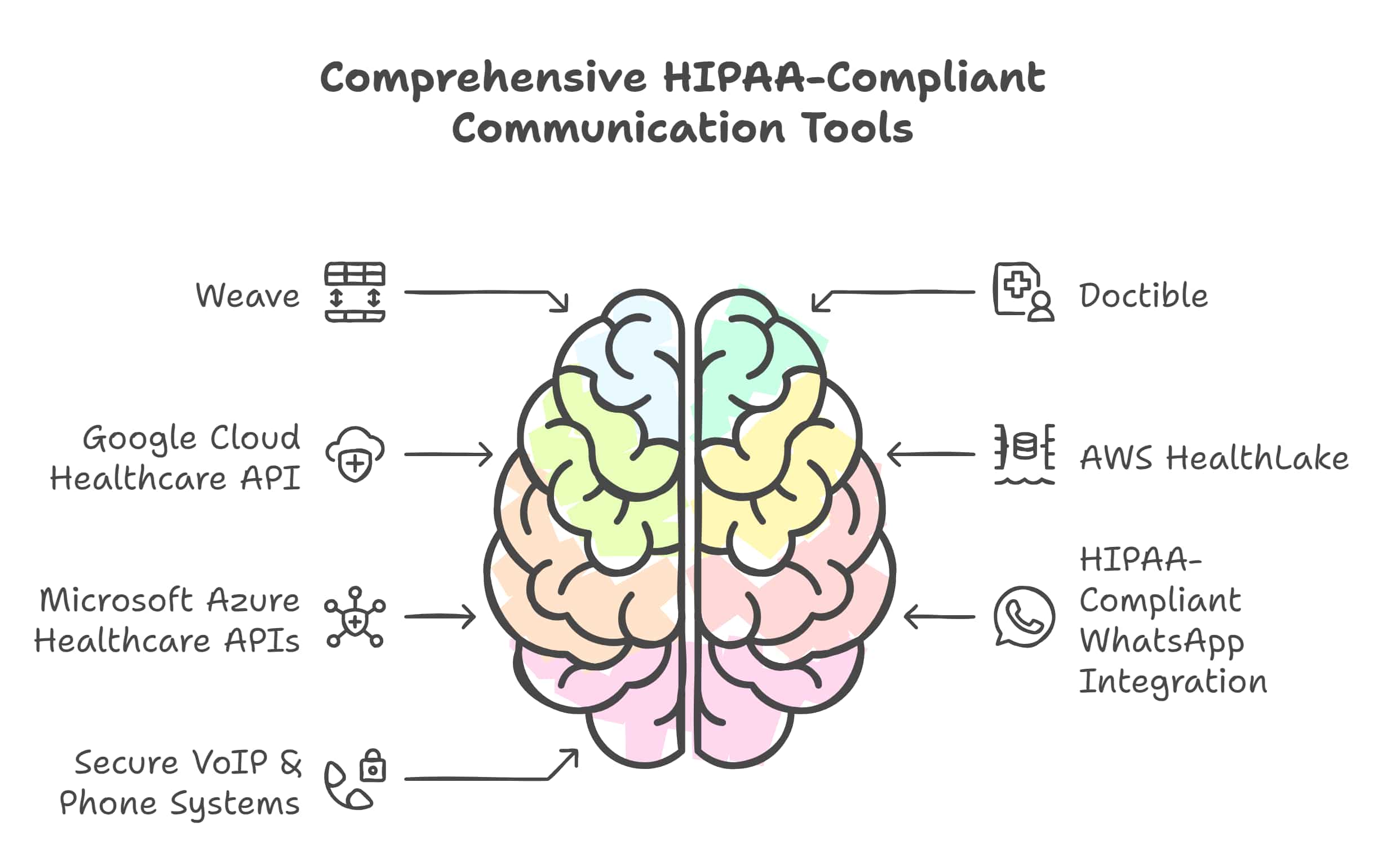
1. Weave – All-in-One Patient Communication Suite
Weave has become incredibly popular in dental practices because it consolidates so many functions into one platform. You get secure two-way texting that patients can use like regular SMS, but it’s fully encrypted and HIPAA-compliant. The VoIP phone system integrates with your practice management software, so patient information pops up automatically when they call.
Appointment reminders go out automatically, and the platform even helps you gather and manage online reviews. Weave provides a signed BAA and takes compliance seriously, making it a solid choice for practices that want an all-in-one solution.
2. Doctible – Patient Engagement & Communication
Doctible focuses specifically on patient engagement for dental practices. Their smart messaging system doesn’t just send reminders—it adapts based on patient behavior and preferences. The online scheduling integration lets patients book directly from your website or social media. Digital forms are customizable to your practice’s needs, and the recall system ensures no patient gets forgotten. Everything runs on HIPAA-compliant infrastructure with proper encryption and access controls.
3. Google Cloud Healthcare API
For larger practices or dental groups with IT resources, Google Cloud Healthcare API provides enterprise-level PHI storage and management. The encryption standards are robust, and the platform offers advanced integration capabilities with other healthcare systems. While it requires more technical expertise to implement, it’s scalable and handles high volumes of data securely.
4. AWS HealthLake
Amazon’s healthcare-focused cloud solution processes and stores health data in a HIPAA-eligible environment. It’s designed for practices that need serious data processing capabilities while maintaining compliance. Like Google’s offering, this is better suited for larger operations with dedicated IT support.
5. Microsoft Azure Healthcare APIs
Microsoft’s healthcare APIs provide a secure communication layer with built-in compliance and audit control features. The platform integrates well with other Microsoft services many practices already use, making it a natural fit for offices heavily invested in the Microsoft ecosystem.
6. HIPAA-Compliant WhatsApp Integration Solutions
WhatsApp is how billions of people communicate globally, and patients increasingly ask if they can message their dentist this way. Standard WhatsApp isn’t HIPAA-compliant, but specialized integration solutions now exist that add the necessary encryption, access controls, and BAA coverage. Several UK and US dental clinics have successfully implemented these workflows for secure messaging, automated reminders, and patient engagement while maintaining the familiar WhatsApp interface patients love.
7. Secure VoIP & Phone Systems for Dental Teams
Beyond the all-in-one platforms, specialized VoIP providers focus exclusively on HIPAA-compliant calling. These systems offer encrypted calling, call recording controls with proper consent mechanisms, and detailed access permissions. They’re ideal for practices that already have other communication tools but need to upgrade their phone system.
Best Practices for HIPAA-Compliant Communication in Dental Offices
Having the right tools is only half the battle. Your team needs to use them properly.
Limit Access with Role-Based Permissions
Not everyone needs access to everything. Your front desk needs different permissions than your dental assistants or billing staff. Configure your tools so each team member sees only what’s necessary for their role.
Use End-to-End Encrypted Messaging
Whenever you’re discussing patient information digitally, ensure the conversation happens through encrypted channels. This applies to internal team discussions about patients and external communication with patients themselves.
Implement Strong Password & MFA Policies
Weak passwords are one of the easiest ways for breaches to occur. Require complex passwords and implement multi-factor authentication (MFA) for all team members accessing patient communication systems.
Encrypt Patient Data Storage
Any stored patient communications, whether text messages, voicemails, or emails, must be encrypted at rest. Check your tool’s settings to confirm this is enabled.
Keep Detailed Audit Logs of All Communication
Your HIPAA-compliant tools should automatically track who accessed what and when. Review these logs periodically and maintain them as required by HIPAA regulations.
Avoid Using Non-Secure Channels
This seems obvious, but it’s worth emphasizing: never use standard SMS, personal Gmail accounts, or personal WhatsApp for anything containing PHI. The convenience isn’t worth the risk.
Common HIPAA Violations in Dental Communication
Learning from others’ mistakes can save your practice from expensive problems:
- Sending PHI over normal SMS without encryption
- Using unsecured personal email accounts to discuss patient cases
- Sharing X-rays or treatment records without proper encryption
- No access controls allowing anyone in the office to see all patient information
- Lack of BAA with software vendors who handle patient data
- Staff discussing patient information in waiting rooms or public spaces where others can overhear
Benefits of Using HIPAA-Compliant Communication Tools
Beyond avoiding fines and breaches, compliant communication tools actually make your practice better:
- Reduced no-shows: Automated reminders with easy confirmation options dramatically decrease missed appointments
- Faster patient response: Secure messaging means patients get answers quickly without phone tag
- Higher satisfaction: Modern patients appreciate digital communication options and convenience
- Secure and compliant workflows: Your team can communicate confidently knowing everything is properly protected
- Better team coordination: Centralized communication platforms keep everyone on the same page
- Less administrative stress: Automation handles routine communications, freeing staff for higher-value interactions
How to Choose the Right HIPAA-Compliant Communication Tool
Use this checklist when evaluating options:
- Does it offer a signed BAA that clearly outlines their responsibilities?
- Does it integrate with your existing dental practice management system?
- Is texting fully encrypted with proper security protocols?
- Does it include all the features you need—reminders, forms, scheduling, VoIP?
- Will it actually reduce workload for your front desk team?
- Is pricing transparent with good customer support available?
FAQs About HIPAA-Compliant Communication Tools for Dental Practices
Can dentists use WhatsApp for patient communication?
Not the standard consumer version. However, HIPAA-compliant WhatsApp integration solutions exist that add necessary security layers, encryption, and BAA coverage, allowing you to use WhatsApp’s interface while staying compliant.
Are appointment reminders considered PHI?
Yes. A message that says “You have a dental appointment tomorrow” reveals that someone is a patient at your practice, which is PHI. All reminders need HIPAA-compliant handling.
What does a BAA include?
A Business Associate Agreement outlines how the vendor will protect PHI, their responsibilities if a breach occurs, how they’ll report incidents, and confirms they’ll comply with HIPAA regulations on your behalf.
Is email safe for dental communication?
Regular email isn’t HIPAA-compliant. You need encrypted email services specifically designed for healthcare that include proper access controls and signed BAAs.
What tools should small clinics pick?
Small practices should look for all-in-one platforms like Weave or Doctible that don’t require dedicated IT staff and bundle multiple communication features with straightforward pricing.
Final Thoughts: Modern Dental Practices Need Secure Communication
Patient communication has evolved, and your practice needs to evolve with it. HIPAA-compliant communication tools aren’t just about avoiding fines—they’re about building trust, improving efficiency, and delivering the modern patient experience people expect. When you invest in the right tools and train your team to use them properly, compliance becomes second nature rather than a constant worry. Your patients deserve to communicate with you conveniently and securely, and your practice deserves the peace of mind that comes with doing things right.


