

Running a business in London leaves very little room for wasted time. Competition is tight, customer expectations are high, and the pace of daily operations never slows down. This is exactly why understanding How London Businesses Can Save 40+ Hours a Month with Automation is becoming essential rather than optional. When repetitive tasks no longer eat into your schedule, entire teams get the freedom to focus on higher-value work.
Automation isn’t a trendy buzzword. It’s a practical tool that gives business owners more time, better accuracy, and a clearer pathway to growth. This guide breaks down how London SMEs can realistically reclaim a full workweek every month—and which processes deliver the fastest results.
Why Time Savings Matter for London-Based Businesses
London is one of the world’s most fast-moving business hubs. Every minute counts, and when routine tasks absorb staff time, productivity slows down. That’s where automation becomes a game-changer. By replacing manual work with automated workflows, your team can achieve more in less time.
Saving 40+ hours a month may sound bold, but it’s a realistic figure for companies that automate even a handful of everyday tasks. For many SMEs, these reclaimed hours turn into stronger customer service, faster response times, and improved revenue.
What Does Saving 40+ Hours a Month Really Look Like?
When broken down, 40 hours a month equals 10 hours a week, or two hours a day. Those extra hours add up fast, and they can transform how a team works. Instead of dealing with admin tasks, staff can work on:
- Client communication and follow-ups
- Sales outreach and nurturing new leads
- Improving internal processes
- Delivering better customer experiences
That shift from low-value tasks to high-impact work creates measurable business growth.
Case Studies: How UK Businesses Are Already Saving 40+ Hours Monthly
Many UK companies have already reached or exceeded the 40-hour benchmark. These real examples show how simple automation delivers powerful results.
A digital marketing agency in London automated its weekly client reports. What once took an employee a full day now takes minutes. As a result, the agency reclaimed 30 hours monthly and improved reporting accuracy.
A retail business in Manchester integrated automated inventory tracking. The system monitored stock levels, updated listings, and triggered reorders instantly. This removed hours of manual data entry and saved the team 50+ hours per month while reducing stockouts by 40%.
A consulting firm used automated scheduling to eliminate back-and-forth email chains. This saved the admin assistant around 15 hours a week, helping the business avoid hiring extra staff.
These examples confirm that ai automation is not just efficient—it’s profitable.
What Determines How Much Time Your Business Will Save?
Not every company will save the same number of hours, but several factors influence the outcome:
- Business size – More staff and departments often mean more opportunities for automation.
- Industry type – E-commerce, finance, real estate, and agencies see faster results due to repetitive processes.
- Current workflows – Businesses still using manual processes will experience immediate savings.
- Automation scope – The more areas you automate, the more hours you reclaim.
Even starting small can produce big improvements.
Best Tasks to Automate to Save 40+ Hours Per Month
To reach the 40-hour benchmark, focus on repetitive, rule-based tasks. These are the easiest to automate and provide the biggest time savings.
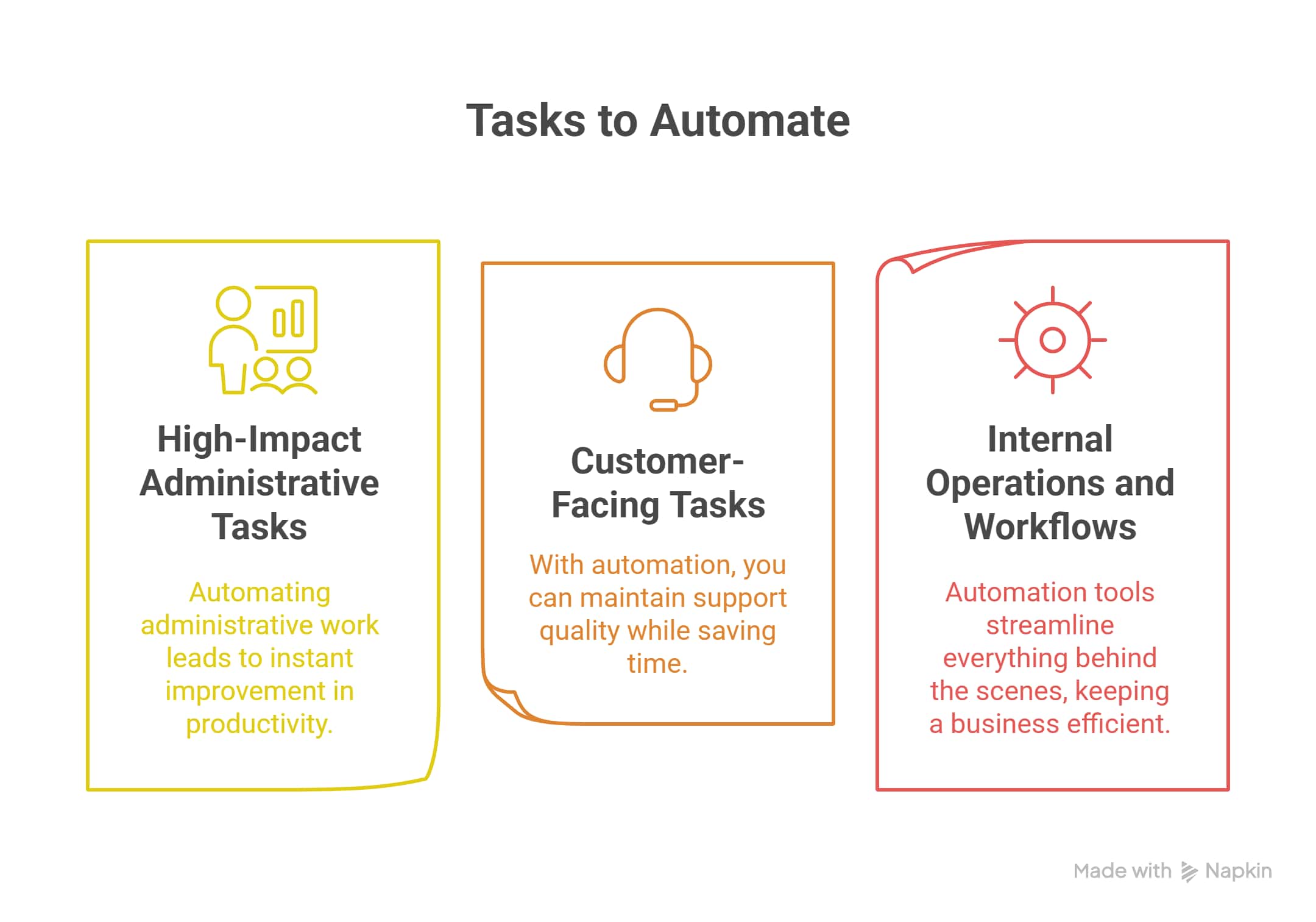
1. High-Impact Administrative Tasks
Administrative work takes up a surprising amount of time. Automating these tasks leads to instant improvement in productivity.
Automated Invoicing
Sending invoices manually slows down cash flow and creates unnecessary delays. Automated invoicing tools can:
- Generate invoices instantly
- Track payments and overdue accounts
- Send scheduled reminders
- Sync data with accounting software
This alone can save several hours every week, especially for busy service-based businesses.
Automated Report Generation
Reports no longer need to be compiled manually. AI Automation services tools can pull data from CRMs, sales systems, social media ads, and analytics platforms to create ready-to-use reports.
Automated Data Entry
When systems move information automatically—such as sending leads from a website form directly into your CRM—errors disappear and hours of manual entry are removed.
2. Customer-Facing Tasks
Customer service is essential but often repetitive. With automation, you can maintain support quality while saving time.
Chatbots
A well-designed chatbot can answer routine questions, take customer details, schedule calls, and provide updates—all without human involvement.
Automated Email Follow-Ups
Nurturing leads and welcoming new clients becomes effortless with automated email sequences that work in the background.
Scheduling Tools
Apps like Calendly eliminate the back-and-forth of booking calls, letting clients choose a time based on your live availability.
3. Internal Operations and Workflows
Smooth internal operations keep a business efficient. Automation tools streamline everything behind the scenes.
Workflow Automation
Tools can automatically assign tasks, update project statuses, send reminders, and notify teams when actions are required.
Approval Processes
Instead of chasing signatures or approvals, automated systems route requests to the right person instantly.
Team Coordination
Daily summaries, deadline reminders, and task updates can be automated to keep teams aligned.
Affordable Automation Tools for UK SMEs
Choosing the right tool is key to maximizing efficiency and keeping costs under control.
Off-the-Shelf Automation Tools
These ready-made tools are ideal for most London SMEs:
- Xero – Accounting, invoicing, and financial automation
- FreeAgent – UK-focused finance automation for freelancers and SMEs
- HubSpot – CRM, email workflows, sales tracking
- Pipedrive – Sales automation and pipeline management
- Zapier – Connects apps and builds automated workflows
- Make (Integromat) – Advanced automation with detailed custom paths
They’re quick to set up, affordable, and require no technical expertise.
Bespoke Automation Solutions
Custom automation offers a perfect match for your processes. While it costs more upfront, it delivers:
- Tailored workflows
- Full integration with internal systems
- Maximum time savings
This is ideal for businesses with unique needs or complex operations.
How to Evaluate ROI Before Investing
Before committing to a tool, evaluate its impact using simple calculations:
- Hours saved per month × employee hourly rate
- Tool subscription cost
- Reduction in errors
- Improved customer satisfaction
- Better cash flow through speed and accuracy
If the value outweighs the cost, automation is worth implementing.
Can Small London Businesses Afford Automation?
Many assume automation is expensive, but modern tools make it surprisingly accessible. SMEs can start small, automate just one or two processes, and see immediate results.
Cost Breakdown
- Setup costs – Often minimal for off-the-shelf tools
- Subscription fees – Typically affordable monthly rates
- Training – Most tools have intuitive interfaces that require light onboarding
Some businesses even access grants or digital adoption funding for adopting new technology.
Examples of UK SMEs Cutting Costs with Automation
Here are typical savings achieved by real companies:
- 20–40% reduction in admin labour
- Faster project turnaround
- Fewer staff needed for repetitive tasks
- Lower error-related costs
- Better cash flow due to automated invoicing
These savings directly support business growth.
How Automation Reduces Human Error
Manual work always carries the risk of mistakes. Automation drastically reduces these errors and improves accuracy.
Data Accuracy
Automated systems transfer data without typos, missing fields, or duplicates.
Document Consistency
Templates ensure consistent formatting, branding, and information.
Compliance Improvements
Automated workflows maintain audit trails and align with industry regulations.
How Automating Invoices and Payments Improves Cash Flow
Cash flow is one of the biggest challenges for London companies. Automation helps by speeding up payments and improving accuracy.
Automated Reminders
Consistent reminders reduce overdue payments without awkward conversations.
Automatic Payment Matching
Transactions are matched instantly with invoices, giving you a real-time financial view.
Faster Billing Cycles
Invoices are sent within minutes, speeding up payments and strengthening working capital.
Will Customer Service Automation Truly Save Hours?
24/7 Availability
Chatbots handle routine queries instantly, reducing inbound message volume.
Reduced Staffing Costs
SMEs can support customers without expanding their team.
Consistent Experience
Automated responses provide accurate information every time.
How Long Does Automation Take to Implement?
Simple Workflows
Tools like Zapier can be launched in days.
Complex Integrations
CRM or finance system integrations may take weeks to months.
Avoiding Delays
Clear goals, early team involvement, and proper testing speed up deployment.
The Productivity and Financial Benefits of Automation
Automation unlocks a powerful mix of productivity and profitability:
- Administrative tasks are completed faster
- Reports are generated instantly
- Costs drop due to fewer errors
- Staff focus on growth instead of admin
- Teams innovate more with newfound time
This shift transforms business performance.
How to Measure Automation Results Accurately
Track the following metrics:
- Hours saved per month
- Cost reductions
- Error rates before vs after
- Customer response times
- Revenue improvements
- Team productivity increases
Using dashboards and clear KPIs makes results easier to measure and scale.
Start With a Pilot Before Going All-In
Running a pilot prevents wasted time and ensures success. Choose one process—like invoicing, reporting, or scheduling—and test automation there first.
Once performance improves, expand automation across operations.
Conclusion — Take the First Step Toward Saving 40+ Hours a Month
Understanding How London Businesses Can Save 40+ Hours a Month with Automation is the first step. The next step is action. Automation gives you more than time—it gives you accuracy, better cash flow, fewer errors, and a stronger competitive edge. Even small changes deliver major results.Start with one repetitive task. Choose the right tool. Build simple workflows.
The time savings you’ll gain each month can transform your business for years to come.


