

The “chatbot” as we knew it is dead. In 2026, that term signals outdated technology friction-heavy interfaces that frustrated users rather than helped them.
The industry has evolved from systems that merely answer questions to intelligent agents that actually solve problems and execute actions autonomously.
But here’s the challenge: businesses are trapped in a valley of disappointment. They deployed cheap generative AI wrappers in 2024 and 2025 that hallucinated wildly, looped endlessly, or simply failed when users needed real help.
What You’ll Learn:
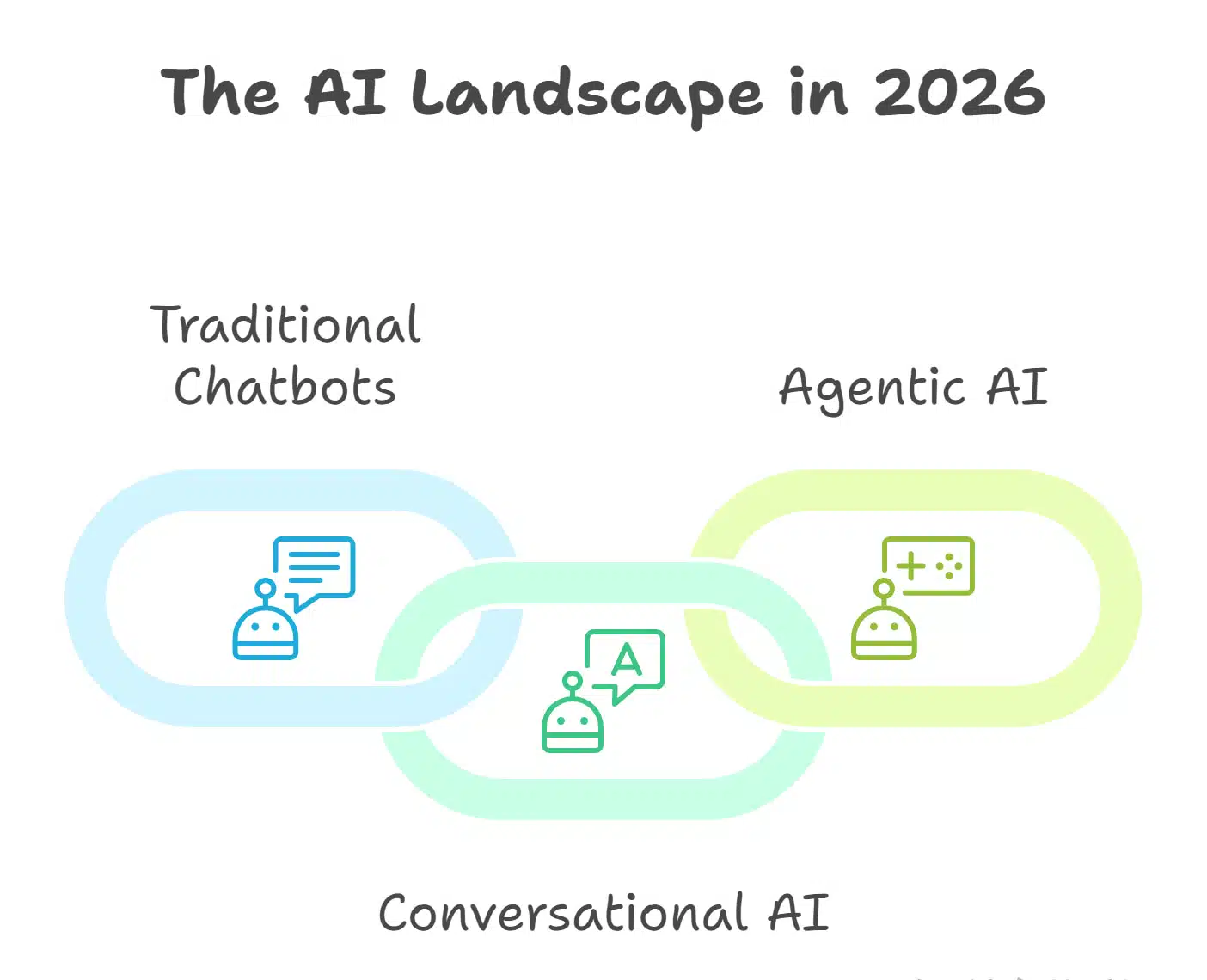
- The critical distinction between rule-based chatbots, conversational AI, and agentic systems in 2026
- When deterministic logic beats probabilistic reasoning (and vice versa)
- The hybrid architecture that leading companies use to balance reliability with intelligence
- A practical decision framework for choosing the right technology for your use case
- Cost analysis that helps you justify investment to finance teams
Defining the Contenders in the 2026 Landscape
Traditional Chatbots: The Click-Path Defenders
Rule-based chatbots operate on strict decision trees with predetermined logic flows. If a user says X, the system responds with Y. No deviation, no interpretation, no creativity.
In 2026, these systems aren’t obsolete they’re specialized. They serve as guardrails in high-compliance industries where unpredictability creates legal liability.
The technology relies on JSON logic, state machines, and button-heavy interfaces that minimize typing and maximize control. Users click through predetermined options rather than expressing needs in natural language.
These chatbots excel in zero-error tolerance scenarios like password resets, payment confirmations, and account verification where following exact procedures is more important than conversational fluidity.
Conversational AI: The Understanding Layer
Conversational AI systems use natural language processing to comprehend user intent and entities, allowing non-linear conversations that feel more human.
This has become the baseline standard in 2026. Users now expect to speak naturally to automated systems rather than learning special commands or navigating rigid menus.
The technology stack includes fine-tuned small language models for speed and privacy, combined with retrieval-augmented generation for accuracy. These systems access knowledge bases to ground responses in verified information rather than generating potentially incorrect answers.
Conversational AI understands that “I need help with my order,” “Where’s my package?” and “Can you check on my delivery?” all express the same underlying intent, routing users to appropriate information regardless of phrasing.
Agentic AI: The Revolutionary Doer
This is where 2026 technology truly diverges from the past. Agentic AI doesn’t just understand and respond it executes actions across multiple systems autonomously.
These systems have “hands” through API integrations and “planning” capabilities through chain-of-thought reasoning. They analyze situations, determine necessary steps, and take action without requiring human intervention for each decision point.
The fundamental shift is from informational to transactional. Instead of saying “Here’s a link to generate your return label,” agentic AI says “I’ve generated your return label, emailed it to you, scheduled courier pickup for 2 PM tomorrow, and processed your refund. Is there anything else?”
This automation extends across platforms updating CRM records, sending notifications through Slack, modifying database entries, and triggering workflows in third-party systems, all within a single conversation.
Comparative Analysis: Script vs. Brain
| Feature | Rule-Based Chatbots | Agentic Conversational AI |
| Logic Core | Rigid decision trees (deterministic) | LLM reasoning plus tool use (probabilistic) |
| Context Window | Short-term (current session only) | Long-term (remembers user history and preferences) |
| Failure Mode | “I didn’t understand that. Please try again.” | Hallucination risk (reduced by 2026 guardrails) or reasoning loops |
| Maintenance | High (manually updating script flows) | Moderate (curating knowledge bases and API definitions) |
| Multimodality | Text and buttons only | Voice, video, screen-sharing, image recognition |
| Personalization | None or basic segmentation | Deep personalization using historical behavior |
| Scalability | Requires manual expansion for new scenarios | Automatically handles novel situations within domain |
| Compliance | Perfect adherence to scripts | Requires monitoring and constraint systems |
This comparison reveals that the choice isn’t about which technology is objectively better, but which characteristics match your specific requirements and risk tolerance.
The 2026 Tech Stack: What Powers Modern Systems
The Hybrid Sandwich Architecture
The most sophisticated implementations in 2026 don’t choose between approaches they combine them strategically.
The “sandwich method” uses large language models to understand user intent and context, but switches to rule-based execution for sensitive actions requiring perfect accuracy.
A user says “I want to transfer five thousand dollars to my savings account.” The conversational AI interprets this natural language request and extracts the key information. Then a deterministic system executes the actual transfer using predefined, tested logic that cannot deviate or make errors.
This architecture delivers conversational fluidity without sacrificing reliability in critical operations.
Edge AI for Speed and Privacy
Latency matters tremendously for user experience. The rise of edge AI allows chatbots to run locally on user devices using small language models like Phi-4 or Llama-4-Nano rather than requiring cloud roundtrips.
This approach reduces response times from seconds to milliseconds while keeping sensitive data on-device for privacy compliance. Healthcare conversations, financial inquiries, and personal information never leave the user’s phone or computer.
Cloud-based conversational AI still handles complex reasoning requiring larger models and extensive knowledge bases, but simple interactions happen instantly through local processing.
Voice as the Primary Interface
Text-based chat dominated early chatbot implementations, but 2026 users overwhelmingly prefer speaking naturally. Human-parity voice models enable conversations that feel indistinguishable from talking to real people.
This shift changes interface design fundamentally. Instead of typing queries and reading responses, users speak while multitasking, receive spoken answers with natural intonation, and interrupt mid-response when they have follow-up questions.
Voice-first conversational AI requires different technical architecture handling interruptions gracefully, managing conversational turns naturally, and processing audio streams in real-time with sub-second latency.
Decision Framework: Choosing the Right Technology
Choose Rule-Based Chatbots When:
Compliance is absolutely critical. Banking, healthcare, and legal industries where an AI “making up” information creates liability require deterministic systems with predictable, auditable behavior.
Scope is intentionally limited. You need to handle five to ten specific tasks like checking order status, resetting passwords, or booking appointments. Adding new capabilities happens rarely enough that manual updates aren’t burdensome.
Budget constraints are severe. Rule-based systems have near-zero per-message costs since they don’t consume expensive API tokens or cloud compute resources for inference.
Perfect consistency matters more than natural conversation. Brand messaging, compliance disclosures, and legal language must be delivered identically every time without variation.
Choose Agentic Conversational AI When:
Complex problem resolution is required. Technical support scenarios where the AI must diagnose unique issues through back-and-forth questioning and contextual reasoning.
Deep personalization drives value. E-commerce experiences that reference purchase history, preferences, and browsing behavior to make relevant recommendations: “I see you bought size ten last time; should we stick with that?”
Cross-platform action is essential. The bot needs to query your CRM, update records in your database, send notifications through Slack, trigger email sequences, and schedule follow-up tasks all within one conversation.
Novel situations arise regularly. Customer inquiries are unpredictable and varied, requiring the system to handle scenarios it wasn’t explicitly programmed to address.
Natural conversation creates competitive advantage. Premium brands where exceptional customer experience justifies higher technology investment and users expect seamless, human-like interaction.
Cost-Benefit Analysis for Finance Teams
Setup Investment
Rule-based chatbots require lower initial development costs because logic flows are straightforward to map and build. However, they become exponentially more expensive to scale as adding new capabilities requires manual coding of additional decision trees.
Agentic conversational AI demands higher upfront investment in model fine-tuning, knowledge base curation, API integration, and safety testing. But once deployed, it scales infinitely as new scenarios emerge without requiring manual updates for each case.
Operational Expenses
Traditional chatbots cost almost nothing per interaction no API tokens, minimal compute, just hosting for simple logic execution.
Conversational AI in 2026 has dramatically lower token costs than early generative systems, but costs still exist. The real operational expense is observability comprehensive monitoring systems that ensure the AI isn’t acting unpredictably or making errors.
ROI Measurement Evolution
The metrics have shifted from deflection rate did we prevent customers from reaching human agents? to resolution rate did we actually solve the customer’s problem completely?
Deflection looked good on dashboards but often meant customers gave up in frustration rather than getting help. Resolution measures true success, even if some cases require eventual human involvement for complete satisfaction.
Calculate ROI by measuring average handling time reduction, customer satisfaction improvement, and employee productivity gains from automation, not just the raw number of automated interactions.
Future-Proofing: What’s Coming in 2027 and Beyond
Self-Improving Agents
The next evolution involves conversational AI systems that analyze their own failed conversations overnight, identify patterns in user frustration or confusion, and autonomously rewrite prompts or update knowledge bases to improve performance.
These systems move from static deployments requiring human optimization to continuously improving agents that get smarter with every conversation.
Proactive AI That Initiates Contact
Current systems wait for users to initiate conversations. Emerging agentic AI monitors context and reaches out proactively: “I noticed your subscription expires in three days. I found a renewal discount code and applied it to your account. Would you like me to process the renewal now?”
This shift from reactive to proactive assistance changes the fundamental nature of customer engagement, moving AI from cost center to revenue driver through intelligent upselling and retention.
Making Your Decision
Don’t choose technology for technology’s sake. If a button solves the problem reliably, don’t build a brain. The simplest solution that meets user needs is always correct.
But if you want to automate actual work rather than just surface information, agentic conversational AI delivers capabilities impossible with traditional approaches.
The key is honest assessment of your use case complexity, risk tolerance, and strategic goals.
Take Action Today
Audit your top ten customer support tickets or user inquiries. If 80 percent are repetitive questions with straightforward answers, build a rule-based chatbot focused on perfect execution of common scenarios.
If 80 percent require judgment, context understanding, and multi-step problem solving, invest in agentic conversational AI that can reason through novel situations.
Most organizations will ultimately deploy both rule-based systems for high-stakes transactions requiring perfect reliability, and agentic AI for complex customer service, sales assistance, and knowledge work automation.
The companies that thrive in 2026 aren’t those that chose the most advanced technology, but those that matched technology capabilities to actual business requirements with clear-eyed realism about both capabilities and limitations.
Your competitive advantage comes not from having AI, but from deploying it strategically where it creates measurable value for customers and your organization.


