

Walk into any busy dental practice around 11:30 AM, and you’ll see the same scene playing out: phones ringing off the hook, patients standing at the front desk waiting to check out, and a receptionist trying to juggle five things at once. Someone calling with a genuine emergency gets sent to voicemail. A new patient ready to book gets frustrated and hangs up. Your team is stressed, patients are annoyed, and revenue is walking out the door.
This is exactly why dental practices across the country are ditching basic chatbots and embracing something far more powerful: AI agents that actually understand dentistry.
Introduction: Why Dental Practices Are Moving Beyond Traditional Chatbots
The dental industry is experiencing a communication revolution, and it’s happening faster than most practice owners realize. The shift isn’t just about keeping up with technology—it’s about survival in an increasingly competitive market where patient expectations have skyrocketed.
Here’s what’s driving this change:
- Rising patient expectations: Today’s patients want instant answers, convenient scheduling, and communication on their terms, whether that’s text, chat, or a quick phone call at 9 PM
- Staff overload and constant phone interruptions: Your front desk team can’t focus on the patient in front of them when the phone rings every three minutes
- Multilingual patient needs: Communities are diverse, and practices serving Spanish-speaking populations need bilingual support without hiring additional staff
- Shift from basic chatbots to advanced AI agents: Simple “click here for hours, click here for services” chatbots feel robotic and frustrating. Patients want real conversations, and AI agents can finally deliver that experience
What Is a Chatbot? (The Old Way)
Before we talk about where we’re going, let’s understand where we’ve been. Traditional chatbots have been around for years, and many dental websites still use them.
How Traditional Chatbots Work
Traditional chatbots operate on rule-based flows that feel more like automated phone menus than actual conversations. They follow scripted responses programmed in advance if a patient types “appointment,” the bot shows scheduling options. If someone types “hours,” it displays your office hours.
These chatbots have limited conversational ability because they can’t understand context or nuance. They simply match keywords to predetermined responses. There’s no deep patient understanding happening—just basic pattern matching that breaks down the moment someone asks something the programmer didn’t anticipate.
Where Traditional Chatbots Fail
Anyone who’s tried to actually use one of these chatbots knows the frustration. They cannot handle complex dental questions like “My crown fell off and it’s sharp can I come in today?” or “Does my insurance cover implants?”
They offer poor language flexibility, often defaulting to “I don’t understand” when patients phrase questions differently than expected. Most importantly, they have no phone call capability, cannot actually schedule appointments in your system, cannot follow up with patients, and cannot think contextually about what a patient really needs.
The result? Patients abandon the chat, pick up the phone instead (defeating the whole purpose), or worse—they go to a competitor’s website.
The New Era — What Is a Dental AI Agent?
AI agents represent a fundamental leap forward from traditional chatbots. Think of the difference between a flip phone and a smartphone—they both make calls, but one is exponentially more capable.
How Dental AI Agents Work (The New Way)
Modern dental AI agents use natural language understanding, which means they comprehend what patients mean, not just what they type. If someone says “I need to get my teeth cleaned,” “It’s time for my checkup,” or “Can I schedule a hygiene visit?” the AI recognizes these are all the same request.
These systems make real-time decisions based on context, your schedule availability, and patient history. AI-driven scheduling means the agent can actually book appointments directly into your practice management system without human intervention.
Perhaps most impressive, these AI agents handle calls, chats, and forms automatically across multiple channels. A patient can start a conversation on your website, continue it via text, and even transition to a phone call—all while the AI maintains context of the entire interaction.
Key Differences Between AI Agents and Basic Chatbots
Context awareness is the game-changer. AI agents remember what was said earlier in the conversation and use that information to provide better responses. If a patient mentions they have anxiety about dental visits, the AI will acknowledge that throughout the conversation and might even note it when scheduling.
Accuracy with dental terminology is another huge advantage. These systems are trained specifically on dental vocabulary, procedures, and common patient questions. They understand the difference between a crown and a bridge, know what “scaling and root planing” means, and can discuss treatment options intelligently.
The 24/7 human-like conversation capability means patients genuinely can’t tell they’re talking to AI in many cases. The responses are natural, empathetic, and contextually appropriate. And because these are true multichannel systems, patients can reach you through webchat, phone, or SMS—whatever works best for them.
Why AI-Powered Chat Systems Work Better for Dental Practices
The benefits translate directly to practice operations and revenue. AI agents handle appointment requests instantly without making patients wait on hold or play phone tag. They respond immediately to questions about insurance, procedures, or available times.
This dramatically reduces front desk stress because routine inquiries and scheduling no longer require staff intervention. Your team can focus on patients in the office and complex situations that genuinely need a human touch.
Multilingual support happens automatically—the AI converses fluently in English, Spanish, or other languages depending on the system. And perhaps most importantly, the engagement feels personalized. The AI references the patient’s name, remembers previous visits, and tailors responses based on their specific situation.
The Spanish-Speaking Patient Advantage
For dental practices serving diverse communities, language barriers have always been a challenge. Hiring fully bilingual staff is expensive and not always possible in every market.
AI agents eliminate this problem through automatic bilingual conversation. A Spanish-speaking patient can ask “¿Tienen citas disponibles esta semana?(Do you have appointments available this week?)” and receive a natural response in Spanish, complete with appointment scheduling—all without any human involvement.
This removes language barriers that might prevent people from seeking care, enhances patient trust by communicating in their preferred language, and dramatically increases appointment conversions. Patients who might have given up trying to communicate with a practice will now book appointments because the process is easy and comfortable.
Why Patients Prefer AI Webchat Over Phone Calls
Patient communication preferences have shifted significantly in recent years, and webchat has become the preferred method for many people, especially younger patients.
The reasons are straightforward: instant responses without waiting on hold, no awkward conversations where reception staff are trying to help while clearly distracted by something else, and private, convenient communication that can happen while they’re at work, on the bus, or wherever.
Most importantly, AI webchat is available after hours and weekends when patients actually have time to think about their dental needs. How many times have patients thought about calling your office at 7 PM, then forgotten by the next morning? AI agents capture those opportunities immediately.
Why Stop at Webchat? Integrate Dental AI into Your Phone System
While webchat is valuable, the real transformation happens when you extend AI to your phone system.
Phone AI: Handling Calls Your Team Can’t Answer
Every dental practice has predictable times when calls go unanswered. After-hours calls from people with genuine emergencies or new patients wanting to schedule. Lunchtime overflow when your receptionist is eating and the phone rings constantly. High-volume days when multiple patients call simultaneously.
An AI phone agent answers every single call, engages professionally, gathers information, and either schedules appointments or routes urgent matters appropriately.
Missed Calls = Missed Revenue
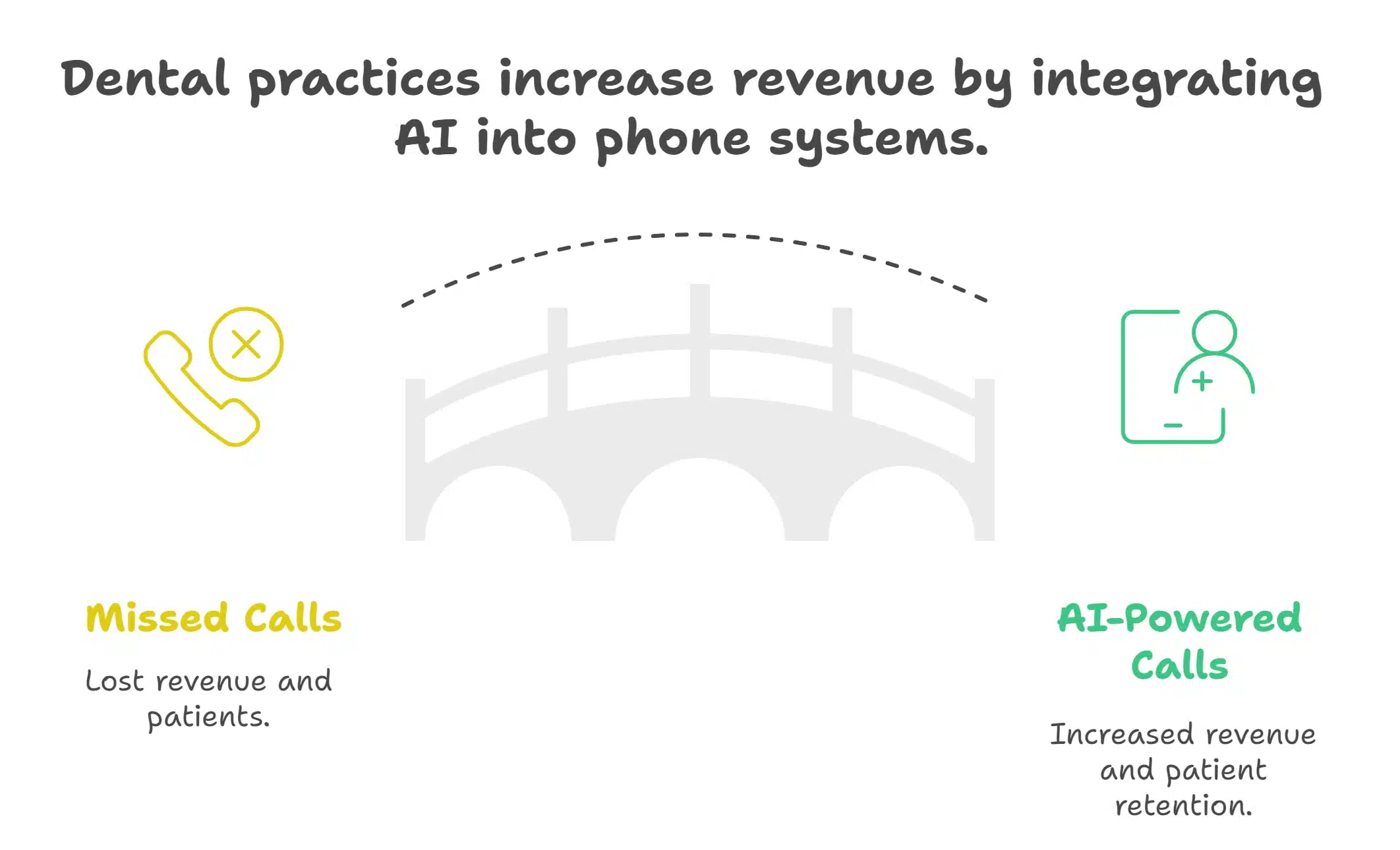
The math is simple but sobering. Every missed call is potentially lost revenue. Lost new patient opportunities represent thousands in lifetime value. Lost emergency cases might seek care elsewhere and never return. Lost recall and hygiene revenue adds up quickly when patients who were ready to schedule couldn’t get through.
Industry research shows that practices lose 20-30% of potential new patient revenue simply from missed or poorly handled phone calls. AI phone agents eliminate this entirely.
Real Benefits of Dental AI Agents (Proven Outcomes)
Let’s talk about measurable results practices are seeing after implementing AI agents.
Capturing After-Hours Revenue
One dental practice in Texas reported booking 37 new patient appointments in the first month from after-hours AI interactions alone. These were people who called or chatted outside business hours—patients they would have never captured before.
Reducing No-Shows
AI agents send automated reminders and confirmations that feel personal, not robotic. They can even text patients the day before asking them to confirm via a simple reply. Practices report no-show reductions of 30-50% after implementing intelligent AI reminder systems.
Improving Patient Experience
Patient satisfaction scores consistently improve when AI agents are implemented properly. Patients appreciate instant answers, easy scheduling, and feeling like the practice is accessible and modern.
Reducing Staff Stress & Burnout
This might be the most important benefit. Dental receptionists consistently rank among the most stressed healthcare workers. Removing the constant phone interruptions and repetitive scheduling questions gives staff mental space to provide better care to patients who need personal attention.
Common Front Office Pain Points That AI Actually Solves
Let’s get specific about the daily frustrations AI agents eliminate.
The Lunch Hour Dilemma
Your receptionist deserves an uninterrupted lunch break, but that’s exactly when many patients try to call. AI agents handle all incoming calls and chats during lunch, scheduling appointments and answering questions without interrupting anyone’s break.
Insurance Questions That Never End
“Do you take my insurance?” “What’s my copay?” “Am I due for a cleaning?” These questions consume massive amounts of reception time. AI agents can access your insurance information and patient records to answer instantly.
Appointment Scheduling Bottlenecks
Scheduling shouldn’t take five minutes per phone call. AI agents handle it in seconds, checking availability, booking the time, and sending confirmation—all while your receptionist helps the patient standing at the desk.
After-Hours Emergencies
A patient with a knocked-out tooth calling at 10 PM shouldn’t get voicemail. AI agents can provide immediate guidance, assess urgency, and even arrange emergency appointments or referrals based on your protocols.
How to Integrate a Dental AI Agent into Your Practice
Implementation is simpler than most practice owners expect, though it does require some planning.
Website installation typically involves adding a chat widget to your site—most AI platforms provide simple code you paste into your website. Phone system integration connects the AI to your existing phone number or provides a dedicated line for AI handling.
PMS/EHR sync is crucial for the AI to access schedules and patient information appropriately while maintaining HIPAA compliance. Training staff takes a day or two, mostly helping them understand what the AI can and cannot do so they know when to step in.
Tracking analytics gives you visibility into every interaction—you can see what patients are asking, when calls are happening, and which responses lead to booked appointments. This data helps you optimize both the AI and your overall practice operations.
AI Tools That Can Transform Your Entire Dental Practice
AI agents for communication are just the beginning. The dental industry is seeing AI implementation across every aspect of practice operations.
Communication AI (Chat + Phone)
This is what we’ve focused on—the AI agents that handle patient conversations, schedule appointments, answer questions, and manage routine communications.
Clinical AI (Diagnostics, Imaging Help)
Emerging AI tools analyze X-rays and scans to identify potential issues dentists might miss, suggest treatment plans based on similar cases, and even predict which patients are at high risk for periodontal disease based on their records.
Billing & Insurance AI
AI systems now verify insurance benefits automatically, predict what patients will owe before treatment, and even follow up on unpaid claims without staff intervention.
Follow-up & Recall AI
Intelligent AI systems track when patients are due for cleanings, follow-ups after procedures, or treatment plan discussions, then reach out automatically with personalized messages that don’t feel like spam.
Introducing Annie AI (Or Replace With Your Product Name)
Among the new generation of dental AI agents, systems like Annie AI represent what’s possible when AI is built specifically for dentistry rather than adapted from general customer service bots.
These specialized systems understand dental procedures, insurance terminology, and the specific workflows of dental practices. They answer calls with natural conversation, handle scheduling across multiple providers and operatories, and provide 24/7 coverage without breaks, sick days, or vacation time.
Use cases range from managing high call volumes during busy seasons, covering after-hours and weekend calls, handling routine appointment scheduling and confirmations, to answering frequently asked questions about procedures and costs.
Don’t Let Your Marketing Efforts Go to Waste
Here’s a frustrating reality: dental practices spend thousands on Google Ads, SEO, and Facebook marketing to drive phone calls and website traffic. Then what happens? Calls go to voicemail because everyone’s busy. Website visitors leave because they can’t get quick answers.
AI agents capture those leads immediately. Every marketing dollar works harder because no opportunity falls through the cracks. The AI answers the call your ad generated, schedules the appointment from the Facebook lead, and responds to the website visitor within seconds.
Marketing drives traffic; AI converts it to booked appointments. It’s that simple.
FAQs
Can AI agents replace human receptionists?
No, and that’s not the goal. AI agents handle routine, repetitive tasks so your human team can focus on complex situations, patient care, and relationship building. Think of AI as expanding your team’s capacity, not replacing it.
Are AI phone agents HIPAA-compliant?
Reputable dental AI platforms are built with HIPAA compliance from the ground up, including encryption, access controls, signed BAAs, and audit logging. Always verify compliance before implementation.
Can AI schedule appointments directly?
Yes, when properly integrated with your practice management system. The AI can view available times, book appointments, and send confirmations just like your receptionist would.
Do AI agents support multiple languages?
Most modern dental AI agents offer bilingual English/Spanish support at minimum, with some supporting additional languages. The AI automatically detects and responds in the patient’s preferred language.
How accurate are dental AI agents?
When trained specifically on dental terminology and common patient questions, AI agents achieve 90-95% accuracy rates. They improve over time as they learn from interactions and receive feedback.
How long does integration take?
Most practices are fully operational with AI agents within 2-4 weeks, including website setup, phone integration, staff training, and system customization. Some simpler implementations can happen in days.
The transformation from basic chatbots to intelligent AI agents represents one of the most significant operational improvements available to dental practices today. The technology finally matches what patients expect and what practices need—real conversations that solve problems, book appointments, and never miss an opportunity. Your competitors are already implementing these systems. The question isn’t whether AI agents will become standard in dentistry, but whether you’ll be leading that change or catching up later.


