

What Are The Main Cost Differences Between Workflow Automation And Manual Work For UK Businesses?
When UK companies compare workflow automation vs manual work, the first question they ask is simple: Which one costs more in the long run? While manual work may appear cheaper at the beginning, it often creates a chain of rising expenses — from labour hours to training, repeat errors, and productivity loss. Automation, on the other hand, requires upfront investment but delivers compounding savings over time.
Upfront Investment Vs Ongoing Labour Costs
The biggest contrast between automation and manual processes lies in timing.
Manual workflows cost less at the start but more every day afterward. Automation costs more at the beginning but significantly less over the long term.
Manual work requires:
- Continuous salaries
- Frequent training
- Replacement staff
- Supervisor oversight
- Additional office resources
Automation requires:
- Implementation setup
- Software configuration
- Occasional maintenance
Once automation is running, the cost per task drops dramatically. Instead of paying for every hour worked, businesses pay for system usage — often a fixed monthly amount.
Comparing Annual Operational Expenses
A typical UK business with manual workflows sees annual expenses driven almost entirely by labour. When employees repeat the same tasks — data entry, approvals, scheduling, documentation — the business pays for time instead of results.
Automation flips this model:
- Manual work = variable cost tied to hours
- Automated workflows = predictable cost tied to systems
As operations grow, manual labour must scale at the same rate. Automation scales without proportional cost increases.
Hidden Costs Often Overlooked By Businesses
Many UK companies underestimate how expensive manual work actually is because certain expenses are buried within daily operations.
Common hidden manual-workflow costs include:
- Micro-delays caused by human bottlenecks
- Error correction and rework
- Employee burnout and turnover
- Slow approvals and project delays
- Reduced customer experience due to slower throughput
Automation removes many of these unseen drains, turning irregular losses into predictable efficiencies.
How Much Can UK Companies Save By Switching From Manual Workflows To Automation?
When comparing ai automation vs manual work, cost savings are one of the most compelling reasons companies decide to switch. Automation consistently reduces operational spending in both small and large UK organisations.
Real-World UK Savings Statistics
Across multiple UK industries, businesses report:
- 30–70% reduction in manual labour costs
- Up to 90% faster task completion
- 40–60% fewer human errors
- 25–50% improvement in team capacity
These savings compound annually, making automation one of the most cost-efficient transformations a business can implement.
Time Saved And Reinvested In Growth
One of the most overlooked financial advantages of automation is the value of time. When employees spend less time on admin work, they can focus on revenue-driven projects.
Examples of productivity reinvestment:
- More time for customer management
- Faster project turnaround
- Improved service delivery
- Higher sales activity
- Greater strategic input from teams
Automation doesn’t replace people — it elevates them to higher-value work.
Key Areas Driving Cost Reductions
The biggest savings come from:
- Lower payroll costs for repetitive roles
- Fewer mistakes requiring costly corrections
- Reduced need for recruitment and onboarding
- Shorter project lifecycles
- Faster customer processing
Together, these create long-term financial advantages that manual work simply cannot match.
What Are The Hidden Costs Associated With Manual Work Compared To Automation?
Manual processes drain resources slowly but consistently. Many of the most expensive issues are not obvious until the business analyses its workflow data.
Recruitment, Training, And Onboarding Expenses
Manual processes rely heavily on people — meaning more hiring, more training, and more turnover. Each new employee adds:
- Recruitment fees
- Training hours
- Reduced productivity during onboarding
- Supervision from senior staff
Automation cuts down the number of repetitive roles needed, reducing churn and hiring cycles.
Error Rates And Rework Costs
Human errors are expensive. Even a small mistake in invoicing, scheduling, data entry, or compliance can create financial damage.
Automation dramatically reduces:
- Duplicate entries
- Miscalculations
- Form errors
- Compliance violations
- Missed deadlines
The more complex the workflow, the greater the risk of human error — and the higher the cost.
Productivity Losses And Opportunity Costs
Manual workflows often slow projects down without anyone noticing. These delays accumulate into major opportunity costs:
- Lost revenue
- Missed leads
- Slower delivery
- Delayed reporting
- Lower customer satisfaction
Automation eliminates these productivity leaks through consistent, fast, and reliable execution.
How Does Time Efficiency Compare Between Automated Workflows And Manual Processes?
Time is a direct cost driver. In the debate of workflow automation vs manual work, speed is a defining factor.
Average Task Completion Times
Manual completion times vary depending on workload, experience, and interruptions. Automated workflows are:
- Predictable
- Consistent
- Always available
- Not limited by working hours
A task that takes a human 20 minutes can often be completed by automation in seconds.
Impact On Business Throughput And Delivery
Higher speed leads to:
- Faster order fulfillment
- Shorter project cycles
- Better customer experience
- More work completed per employee
Automation allows UK companies to handle more work with the same team — something manual processes cannot scale.
Employee Time Allocation Differences
In manual environments, much of the working day goes to repetitive admin tasks. Automation frees employees from low-value work such as:
- Data entry
- File transfers
- Routine approvals
- Scheduling
- Reporting
This shift boosts morale and allows teams to focus on meaningful contributions.
What Is The Impact Of Error Rates On The Overall Cost In Manual Vs Automated Workflows?
Error reduction is one of the strongest financial arguments for automation.
Financial Consequences Of Human Errors
Errors lead to direct and indirect costs:
- Refunds and compensation
- Compliance fines
- Delayed projects
- Corrective work
- Loss of customer trust
In highly regulated UK industries, human mistakes often carry high penalties.
Automation’s Role In Reducing Mistakes
Automation ensures tasks are executed correctly every time. Systems:
- Validate data
- Follow rules
- Maintain consistent workflows
- Eliminate fatigue-based mistakes
As processes become more accurate, business finances stabilise.
Long-Term Cost Benefits Of Accuracy
Higher accuracy protects:
- Profit margins
- Customer retention
- Brand reputation
These are long-term financial multipliers often underestimated by manual-first organisations.
How Do Upfront And Long-Term Costs Differ For Manual Work Versus Workflow Automation?
The comparison of workflow automation vs man work comes down to how costs evolve over time.
Initial Setup And Implementation Expenses
Automation requires:
- Software setup
- System configuration
- Integration work
However, these are one-time costs.
Manual work requires no setup — but becomes more expensive every year.
Ongoing Maintenance Vs Staff Salaries
Automation maintenance is predictable and low-cost. Salaries increase through:
- Annual raises
- Pension contributions
- Holiday pay
- Sick days
As teams grow, expenses compound.
ROI Time Frames And Break-Even Analysis
Most UK companies recover their automation investment within:
- 6 to 18 months depending on workflow complexity
After this point, savings accelerate.
What Factors Should UK Businesses Consider When Deciding Between Manual Work And Automation?
The decision depends on the company’s structure, workflow complexity, and future goals.
Business Size And Workflow Complexity
Automation benefits:
- Medium to large businesses
- High-volume operations
- Compliance-heavy processes
- Multi-step workflows
Smaller companies also gain value but may automate fewer areas initially.
Cost-Benefit Analysis And Risk Assessment
Businesses should evaluate:
- Current labour costs
- Error frequency
- Staff turnover
- Time inefficiencies
- Compliance needs
The more complex and repetitive the workflow, the higher the return on automation.
Scalability And Future Growth Potential
Manual work hits capacity quickly. Automation supports:
- Unlimited workflows
- Expanded service delivery
- Multi-department integration
- Higher output without hiring
This makes it ideal for rapidly growing UK companies.
How Does Staff Cost And Onboarding Influence The Expense Of Manual Workflows?
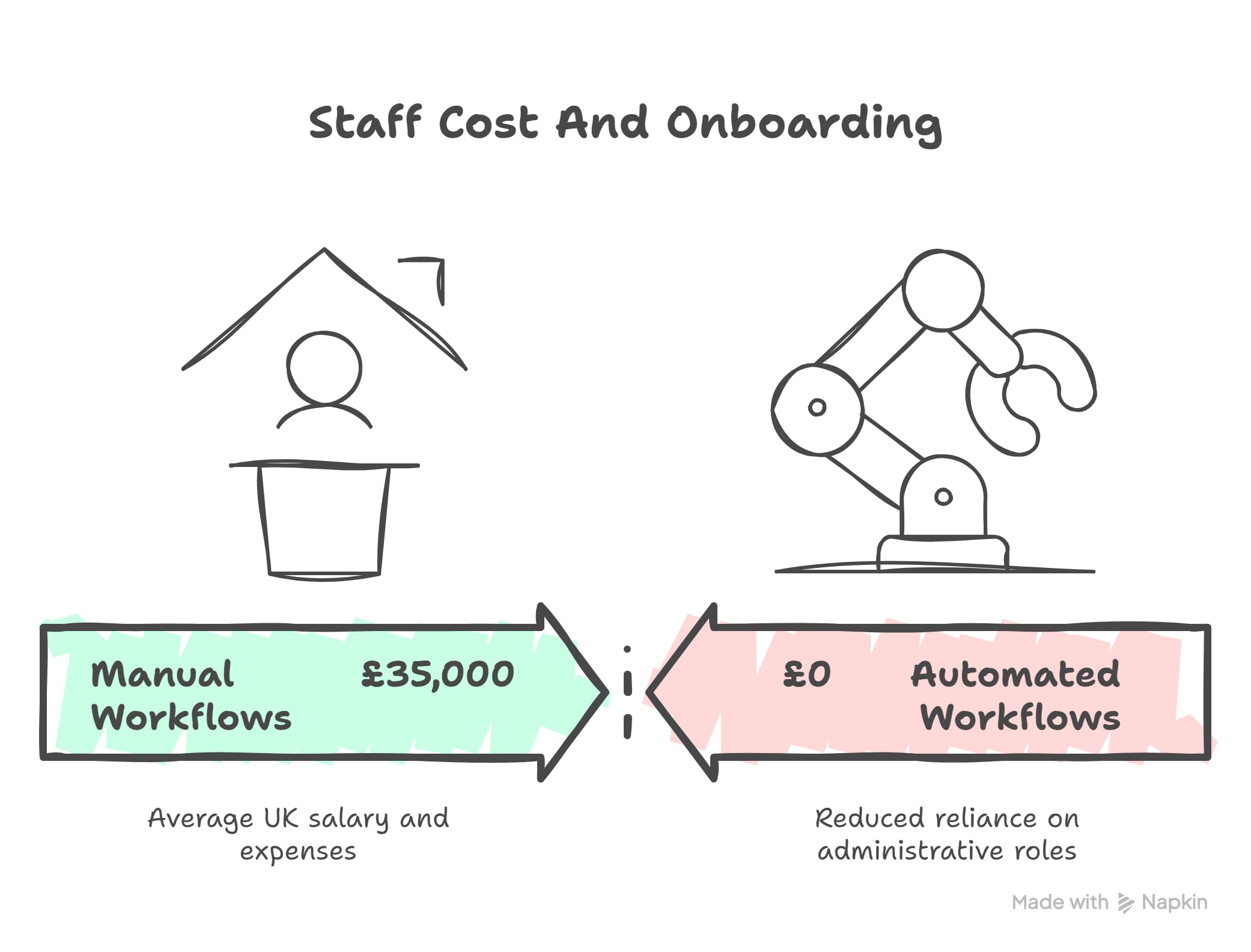
Staff-driven workflows require constant financial investment.
Average UK Salaries And Associated Expenses
Employees performing manual tasks generate additional costs:
- National Insurance
- Pension contributions
- Training time
- Equipment and software
Automation reduces reliance on administrative roles.
Turnover And Recruitment Cycle Impact
Manual jobs often suffer from:
- High burnout
- Frequent turnover
- Rising hiring expenses
Automation creates more stable, engaging roles.
Training And Development Overheads
Manual workflows constantly require training for:
- New systems
- Updated processes
- Compliance requirements
Automated workflows reduce training load significantly.
What Industries In The UK Benefit Most From Switching To Workflow Automation In Terms Of Cost?
Some sectors naturally gain higher returns from automation.
High-Volume Document Processing Sectors
Such as:
- Financial services
- Insurance
- Real estate
- Legal firms
Automation eliminates paperwork bottlenecks.
Manufacturing And Supply Chain Efficiencies
These industries achieve:
- Better accuracy
- Faster processing
- Lower overheads
Automation supports lean, predictable operations.
Professional Services And Compliance-Driven Fields
Including:
- Healthcare
- Accounting
- HR services
- Consultancy
Automation ensures consistent delivery and reduced risk.
How Do Operational Productivity And Scalability Compare Between Manual And Automated Workflows?
The final comparison highlights why automation is now a growth tool rather than a cost.
Measuring Productivity Gains From Automation
Automation increases:
- Speed
- Accuracy
- Consistency
- Output
Businesses complete more work with fewer resources.
Manual Process Limitations On Growth
Manual workflows struggle with:
- Increased workload
- Rising labour costs
- Slower delivery
- Higher error risk
This limits how far a business can grow without major hiring.
Automation’s Advantage In Scaling Operations
Automation allows UK companies to scale smoothly:
- More tasks
- Higher customer volume
- Expanded services
- Faster turnaround


