

The AI voice agent market is exploding, and businesses are desperately searching for AI receptionists, sales diallers, and automated support agents that actually sound human.
Smart agencies are capitalizing on this demand by launching their own AI voice services—but there’s a problem.
Building a voice AI system from scratch requires combining large language models, speech-to-text transcribers, text-to-speech synthesizers, and telephony infrastructure—an engineering nightmare costing hundreds of thousands of dollars.
What You’ll learn:
- Why white label AI voice platforms let you launch your own AI agency in days, not years
- The critical difference between no-code reseller platforms and API-first developer engines
- Detailed reviews of the top 7 white label AI voice agent platforms with real pricing
- How to price your AI voice services for maximum profitability
- Which platform matches your technical skills and target market
The White Label Advantage: Your Brand, Their Technology
White labelling allows agencies to resell powerful voice AI technology under their own brand, domain, and pricing structure without writing a single line of code or building infrastructure.
Instead of telling clients “we use Vapi,” you tell them “we built our proprietary AI voice system.” The technology runs in the background while your brand takes centre stage.
This approach eliminates the impossible barrier to entry that would otherwise require machine learning expertise, telephony partnerships, and millions in development costs. You focus on sales, client relationships, and industry specialization while the platform handles the technical complexity.
The result is a scalable AI voice agency that generates recurring revenue through monthly retainers and per-minute usage markups without the engineering headaches of building your own infrastructure.
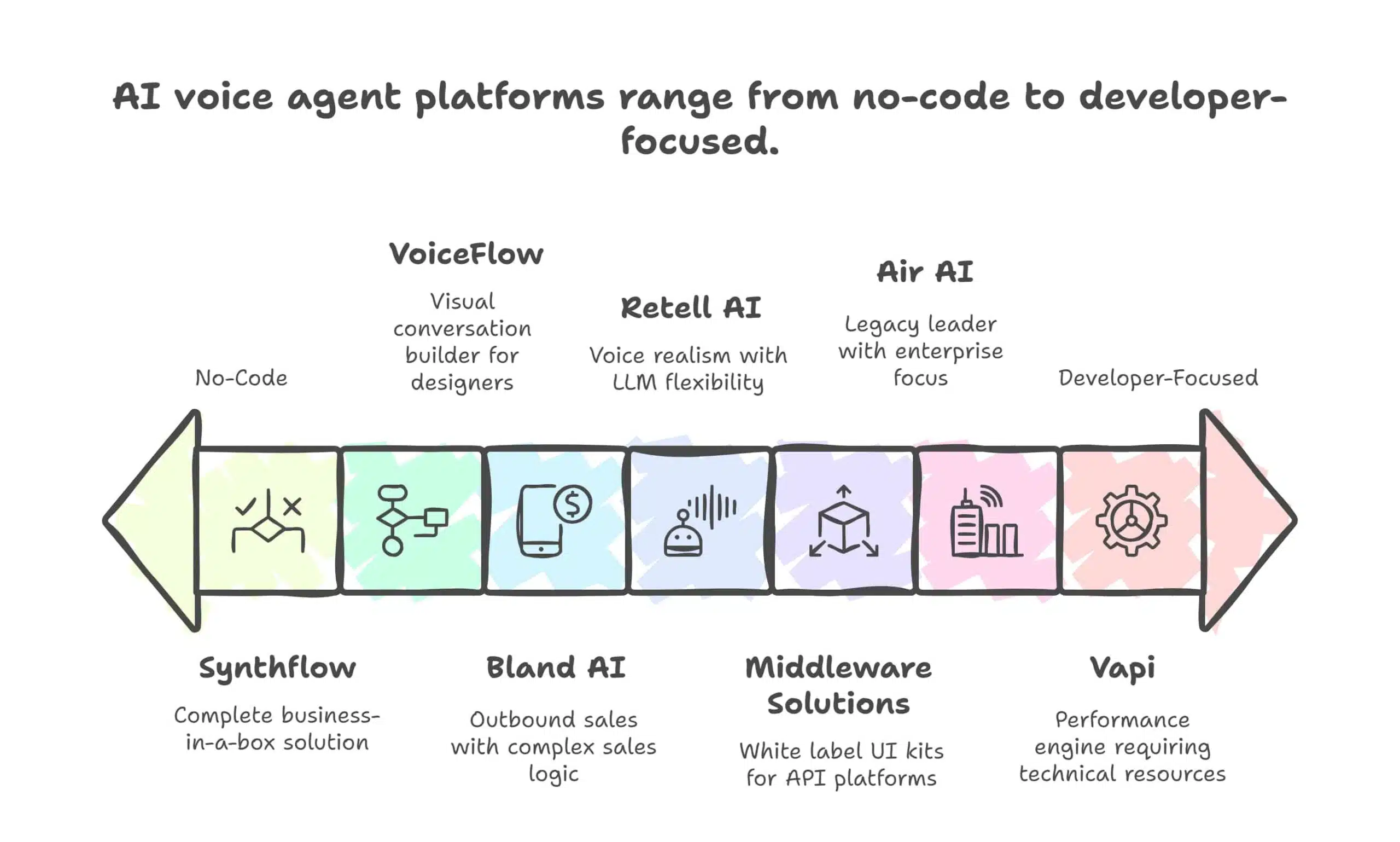
Understanding the Ecosystem: Two Types of White Label Platforms
Before diving into specific platforms, you need to understand a crucial distinction that determines which solution fits your agency.
Type A: All-in-One No-Code Resellers
These platforms are specifically built for agencies with limited technical resources. They provide complete white label dashboards where your clients can log in, manage their AI agents, and view analytics—all under your branding.
The platform handles user interface design, billing systems, subaccount management, and customer portals. You simply add your logo, set your pricing, and start selling. No coding required.
The tradeoff is less flexibility. You’re constrained by the features the platform offers, though for most agencies selling to small and medium businesses, these limitations rarely matter.
Type B: Developer Engines (API-First)
These are high-performance voice AI engines designed for developers who want maximum control and customization. They offer incredible technical capabilities—sub-second latency, advanced interruption handling, and unlimited customization options.
However, they’re just the engine. You need to build your own dashboard, create client portals, implement billing systems, and develop the entire user interface. Most agencies using these platforms either have in-house developers or purchase third-party “wrapper” solutions that provide the missing frontend layer.
The result is a more powerful, customizable solution that requires technical expertise or additional investment in development resources.
Top White Label AI Voice Agent Platforms: Detailed Reviews
1. Synthflow: Best Overall for No-Code Agencies
Synthflow dominates the no-code white label space by offering the most complete business-in-a-box solution for agencies without technical teams.
Key Features:
The platform provides true white label dashboards with client login portals where your customers manage their AI agents without ever seeing the Synthflow brand. Your logo, your domain, your pricing structure.
The drag-and-drop builder requires zero coding knowledge. You create sophisticated voice agents by connecting visual blocks that define conversation flows, integrations, and business logic.
Native integrations with GoHighLevel and HubSpot make Synthflow particularly attractive for marketing agencies already using these platforms. Your AI voice agents connect directly to existing CRM workflows.
The platform handles billing, sub-accounts, and usage tracking automatically. You set markup percentages, and Synthflow manages the financial infrastructure including payment processing and invoice generation.
Best For: Marketing agencies, GoHighLevel users, and non-technical founders who want to launch AI voice services immediately without hiring developers.
Pricing Model: Starts around ninety-seven dollars monthly for basic white label access, with per-minute usage fees that you markup for profit.
2. Vapi: Best for Performance and Developers
Vapi has become the gold standard engine powering many of the voice agents you interact with daily, even if you don’t realize it.
Key Features:
The platform delivers sub-second latency that feels genuinely instant during conversations. When users speak, the AI responds so quickly that conversations flow naturally without the awkward pauses that plague inferior systems.
Interruption handling is the best in the industry. Users can cut off the AI mid-sentence, and Vapi responds immediately to the new input rather than finishing its previous thought—essential for natural conversation flow.
The system is highly customizable with granular control over every aspect of the voice agent’s behavior, from speaking speed to conversation context management.
White Label Reality: Vapi is primarily API-based. While incredibly powerful, you need technical resources to build a frontend dashboard, implement client portals, and create the billing infrastructure. Many agencies pair Vapi with white label wrapper solutions to get the best of both worlds.
Best For: Technical founders, agencies with development teams, or businesses using third-party wrapper solutions to create white label offerings powered by Vapi’s engine.
Pricing Model: Pay-per-minute usage starting around twelve cents per minute with volume discounts.
3. Bland AI: Best for Outbound Sales and Cold Calling
Bland AI specializes in high-volume outbound calling with sophisticated sales logic that makes AI callers nearly indistinguishable from human sales development representatives.
Key Features:
The “Pathways” feature allows complex branching sales scripts that adapt based on prospect responses. If a prospect says they’re interested, the AI follows one conversational path. If they object, it pivots to objection handling.
Seamless call transfers to human agents ensure that when AI identifies a qualified lead, the handoff to your sales team happens smoothly with full context of the conversation.
The platform offers a specific white label partner program designed for agencies focusing on outbound lead generation and appointment setting.
Best For: Agencies targeting real estate, solar sales, insurance, and other industries where outbound calling drives revenue. Particularly strong for lead qualification and appointment setting services.
Pricing Model: White label partnership pricing varies, typically requiring minimum monthly commitments with per-minute usage fees.
4. Retell AI: Best for Voice Realism and Premium Clients
Retell AI has earned its reputation by producing the most human-sounding AI voices available, complete with natural breathing, realistic pauses, and emotional responsiveness.
Key Features:
The platform is LLM-agnostic, allowing you to connect your own API keys from OpenAI, Claude, or Groq. This flexibility lets you optimize for cost, capability, or specific use cases without being locked into one provider.
Developer documentation is exceptionally thorough, making implementation straightforward for technical teams despite the platform’s advanced capabilities.
Voice quality exceeds competitors with nuanced intonation, natural speech patterns, and realistic emotional expression that premium clients demand.
Best For: Agencies serving healthcare, luxury hospitality, high-ticket concierge services, and other industries where voice quality directly impacts brand perception and customer experience.
Pricing Model: Usage-based pricing with costs varying depending on which LLM provider and voice synthesis options you select.
5. VoiceFlow: Visual Conversation Builder
VoiceFlow takes a designer-friendly approach to voice agent creation with emphasis on visual conversation mapping and multi-channel deployment.
Key Features:
The visual canvas lets non-developers map entire conversation flows graphically, making complex dialogue trees easier to understand and modify than code-based approaches.
Multi-channel deployment means agents built in VoiceFlow work across phone systems, web chat interfaces, and messaging platforms from a single build.
Team collaboration features allow multiple stakeholders to review, comment on, and refine conversation designs without technical barriers.
Best For: Agencies with design-focused teams and clients requiring omnichannel presence beyond just voice calling.
Pricing Model: Tiered subscription pricing starting around fifty dollars monthly with white label capabilities in higher tiers.
6. Air AI: Legacy Leader with Enterprise Focus
Air AI was among the first platforms to offer truly conversational AI phone agents and maintains strong enterprise relationships, though it’s become less accessible to smaller agencies.
Key Features:
Long conversation capability allows AI agents to handle extended calls exceeding thirty minutes without losing context or coherence—essential for complex customer service scenarios.
Enterprise-grade security and compliance features meet the stringent requirements of large corporations and regulated industries.
Current Reality: Air AI has pivoted toward direct enterprise sales rather than agency partnerships, making it less accessible for smaller white label operations than it once was.
Best For: Established agencies with enterprise clients and significant contract values justifying higher investment.
7. Middleware Solutions: ConvoCore and Similar Wrappers
These aren’t voice engines themselves but rather white label UI kits that sit on top of powerful API-first platforms like Vapi or Retell.
The Value Proposition:
You get the performance advantages of best-in-class engines like Vapi combined with ready-made white label dashboards, client portals, and billing systems—without hiring developers.
These solutions bridge the gap between the ease of all-in-one platforms and the power of developer-first engines.
Best For: Agencies that want Vapi-level performance but need a complete white label business system without building it from scratch.
Pricing Model: Monthly licensing fees typically ranging from two hundred to five hundred dollars plus the underlying platform’s usage costs.
Platform Comparison: At a Glance
| Platform | Ideal User | Pricing Model | Latency | True White Label |
| Synthflow | No-code agencies | $97/mo + usage | 800-1200ms | Yes (complete) |
| Vapi | Developers | Usage only ($0.12/min) | 300-600ms | No (API only) |
| Bland AI | Outbound sales teams | Partnership tiers + usage | 600-900ms | Yes (partner program) |
| Retell AI | Premium voice quality | Usage based | 400-700ms | Partial (API-first) |
| VoiceFlow | Design-focused teams | $50-200/mo tiers | 1000-1500ms | Yes (higher tiers) |
| Air AI | Enterprise clients | Custom enterprise pricing | 500-800ms | Limited availability |
| Wrapper Solutions | Power without coding | $200-500/mo + engine costs | Depends on engine | Yes (complete) |
This table reveals a clear pattern: you’re choosing between ease-of-use and performance, with pricing and white label capabilities varying accordingly.
Critical Features to Evaluate When Choosing Your Platform
Latency: The Pause That Kills Sales
Latency measures the delay between when a user stops speaking and when the AI begins responding. Anything over one thousand milliseconds creates awkward pauses that make conversations feel robotic and frustrating.
Premium platforms achieve sub-600ms latency, creating conversations that feel genuinely instant. Budget platforms often exceed 1500ms, which is noticeable and unprofessional.
Interruptibility: The Natural Conversation Test
Can users interrupt the AI mid-sentence like they would interrupt a human? This capability is essential for natural conversation flow.
Inferior systems force users to wait until the AI finishes speaking before accepting new input, creating frustrating experiences where users talk over the AI without being heard.
BYOC: Bring Your Own Carrier
Some platforms lock you into their telephony infrastructure at their pricing. Better platforms allow you to connect your own Twilio or Vonage account, giving you control over telephony costs and margins.
This matters significantly at scale. The difference between twelve cents and eight cents per minute becomes thousands of dollars monthly when you’re handling high call volumes.
Client Billing and Rebilling Capabilities
Can the platform automatically handle client billing with your markup included? You need systems that invoice clients, process payments, and track usage per client without manual spreadsheet management.
The best platforms provide complete billing infrastructure including payment processing, invoice generation, usage tracking per sub-account, and automated collections.
How to Price Your White Label AI Voice Services
Successful agencies use a three-revenue-stream model that maximizes profitability while aligning incentives with client success.
The Setup Fee
Charge between five hundred and two thousand dollars for initial agent development, prompt engineering, integration configuration, and testing. This compensates you for the strategic work of understanding the client’s business and building a customized solution.
Higher-touch industries like healthcare or legal justify premium setup fees of three thousand to five thousand dollars due to compliance requirements and specialized knowledge needed.
The SaaS Retainer
Monthly platform access fees typically range from ninety-seven to two hundred ninety-seven dollars depending on features, analytics access, and support levels included.
This recurring revenue provides predictable cash flow and covers your white label platform costs while generating profit margin.
The Usage Markup
If you’re paying twelve cents per minute to the underlying platform, sell to clients at eighteen to twenty-five cents per minute. This markup generates substantial profit on high-volume use cases.
For appointment setting services handling thousands of calls monthly, usage markup becomes your most profitable revenue stream. A client making five thousand minutes of calls monthly generates six hundred to thirteen hundred dollars in markup profit alone.
Choosing Your Niche: The Path to Premium Pricing
Generic “AI voice agents for any business” positioning forces you to compete on price with hundreds of other agencies making identical claims.
Instead, specialize in a specific vertical where you develop deep expertise in that industry’s unique needs, compliance requirements, and conversation patterns.
High-Value Niches:
Dental practices need appointment scheduling, reminder calls, and patient reactivation campaigns with HIPAA compliance.
Real estate agencies require lead qualification, property inquiry handling, and showing scheduling with local market knowledge.
Home services businesses need emergency call routing, appointment booking, and service inquiry handling with seasonal demand fluctuations.
Healthcare facilities require patient intake, insurance verification, and appointment management with strict privacy compliance.
Vertical specialization allows you to charge premium prices because you’re not selling technology—you’re selling industry expertise delivered through AI automation.
Your Platform Selection Strategy
If you have no technical team and want to launch quickly, choose Synthflow or a similar all-in-one platform. You sacrifice some performance for complete business infrastructure and immediate go-to-market capability.
If you have developers or budget for wrapper solutions, choose Vapi or Retell as your engine and build or license the frontend layer. This path delivers superior performance and customization at the cost of complexity.
If you’re focused specifically on outbound sales and cold calling, Bland AI’s specialized features and sales-focused tooling justify the platform choice despite the partnership requirements.
The most successful agencies don’t choose platforms based on features alone but rather based on alignment between the platform’s strengths, their technical capabilities, and their target market’s needs.
Launch Your AI Voice Agency Today
The AI voice revolution is happening now, not in some distant future. Businesses are actively searching for solutions, and the agencies that move first in their chosen verticals will establish market leadership before competition intensifies.
Start by selecting a platform that matches your technical capabilities and testing it with a pilot client in your target industry. Document the results, refine your processes, and package your offering into a clear service with defined deliverables and pricing.
Then scale through targeted outreach to similar businesses in your niche, leveraging case studies and industry-specific messaging that demonstrates you understand their unique challenges.
The opportunity is massive, the technology is proven, and white label platforms have removed the technical barriers that would have made this impossible just two years ago. Your move.
What Is the Best White Label Voice AI Platform?
The best platform depends on your technical skills and the type of clients you serve.
Best options by use case:
- Non-technical agencies: Synthflow
- High-performance developers: Vapi
- Outbound sales teams: Bland AI
- Premium voice realism: Retell AI
- Power + no coding: Wrapper solutions
| Goal | Recommended Type |
|---|---|
| Fast launch | No-code platform |
| Maximum control | API-first engine |
| Enterprise clients | API-first |
| Local SMB clients | All-in-one reseller |
Choose based on skill level, niche, and growth plan.
What Is White Label AI Calling Software?
White label AI calling software allows agencies to:
- Sell AI phone agents under their own brand
- Add markup to per-minute usage
- Provide clients with branded dashboards
- Manage sub-accounts
- Automate billing
You do not build infrastructure.
You sell and manage the service.
This is ideal for:
- Marketing agencies
- Lead generation agencies
- Clinics and service businesses
Synthflow vs Other White-Label AI Bot Tools for Agencies
Here’s the quick comparison agencies need:
| Feature | Synthflow | API-First Platforms |
|---|---|---|
| Coding Required | No | Yes |
| Branded Dashboard | Yes | Must build |
| Billing Built-In | Yes | Must build |
| Latency | Moderate | Faster |
| Customization | Limited | High |
Choose Synthflow if:
- You want fast setup
- You have no developers
- You want built-in billing
Choose API tools if:
- You need full customization
- You have technical resources
- Performance is critical
Which Platforms Are Used by Enterprise Clients for Licensing Custom Voices?
Enterprise clients usually choose platforms that offer:
- Custom voice licensing
- Voice cloning
- High security
- Compliance features
- Long-call memory
Most commonly used types:
| Platform Type | Enterprise Fit |
|---|---|
| Retell-type engines | Strong |
| Vapi-type engines | Strong |
| No-code resellers | Limited |
Enterprises prioritize voice quality and security over simplicity.
Which Vendor Can White-Label an AI Agent With Our Clinic’s Branding?
If you run a clinic or healthcare business, look for:
- Custom domain login
- Full dashboard branding
- Logo replacement
- HIPAA-ready integrations
- Secure call storage
Best fit:
- Complete white-label platforms
- API engines paired with wrapper dashboards
Always confirm compliance before signing.
What Solution Offers White-Label Authentication Flows?
For secure integrations, your platform should support:
- Role-based user access
- Sub-account permissions
- OAuth integrations
- API key management
- Secure webhooks
API-first engines offer deeper control.
No-code platforms offer simpler built-in user systems.
FAQ
What is white label AI voice software?
It is software that allows agencies to resell AI voice agents under their own brand without building the technology themselves.
Can AI voice agents be fully branded?
Yes. Many platforms allow custom logos, domains, dashboards, and client portals.
Do white label platforms handle billing?
Some all-in-one platforms include billing and rebilling. API-first platforms require you to build or integrate billing systems.
Are AI voice platforms secure for healthcare use?
Enterprise-grade platforms offer compliance features, but always confirm HIPAA or GDPR support before using them.


