

Your inbox is overflowing with unread messages. Your calendar shows back-to-back meetings with no time to process what was discussed. Your global team struggles to collaborate across language barriers and time zones.
This is the communication crisis facing modern businesses—and artificial intelligence is rewriting the rules entirely.
AI in business communication isn’t replacing human connection. It’s removing the friction that prevents genuine collaboration, making interactions faster, clearer, and more inclusive than ever before.
What You’ll Discover:
- How real-time AI translation eliminates language barriers for global teams
- The meeting revolution that transforms time-sinks into strategic assets
- Generative AI tools that speed up email writing while improving tone
- Customer-facing AI that delivers hyper-personalization at scale
- The risks of over-reliance and how to maintain authentic human connection
Key Benefits of AI in Business Communication
Before diving deep, here’s what AI delivers to modern organizations:
Efficiency: Reduces time spent on emails and meeting notes by 40 percent or more through automated transcription and generative drafting.
Clarity: Eliminates language barriers and grammar errors with real-time translation and intelligent writing assistance.
Insight: Provides actionable data on sentiment analysis and engagement levels across all communication channels.
Availability: Enables 24/7 responsiveness for customers through conversational AI that never sleeps.
The Death of the Language Barrier
Global teams face a fundamental challenge: how do you collaborate effectively when team members speak different native languages?
Real-Time Translation That Actually Works
Modern AI meeting assistants like Microsoft Teams Premium and Zoom AI now translate conversations in real-time with remarkable accuracy. A sales call between English-speaking executives and Japanese clients happens seamlessly, with each participant hearing the conversation in their native language.
This technology extends beyond simple word-for-word translation. Natural language processing understands context, idioms, and cultural nuances that earlier machine translation missed entirely.
The impact on remote-first organizations is transformative. Companies no longer restrict hiring to specific geographic regions based on language requirements. A developer in Brazil collaborates effortlessly with designers in Korea and product managers in Germany.
Localization at Scale
Marketing teams face the challenge of adapting campaigns for different regions while preserving brand voice and cultural relevance. Generative AI for business now handles transcreation going beyond direct translation to adapt messaging for local context.
A product launch campaign developed in English gets intelligently adapted for Spanish-speaking markets, French-speaking regions, and Asian markets with culturally appropriate references, humor, and emotional resonance that direct translation would destroy.
This capability that once required expensive agencies and weeks of back-and-forth now happens in hours, enabling truly global marketing campaigns from mid-sized companies.
Revolutionizing Meetings: From Time-Sinks to Assets
The average professional spends 23 hours per week in meetings, with research showing that 71 percent of those meetings are unproductive. AI is fundamentally changing this equation.
Automated Transcription and Action Items
Tools like Otter.ai, Fireflies.ai, and Microsoft Copilot attend meetings alongside human participants, automatically generating complete transcriptions, identifying action items, and summarizing key decisions.
Instead of designating someone to take notes effectively removing them from active participation everyone engages fully while AI captures everything. Within minutes of the meeting ending, participants receive summaries highlighting who committed to what by when.
This automated meeting documentation creates searchable institutional knowledge. Six months later, when questions arise about why a particular decision was made, teams search meeting transcripts rather than relying on imperfect human memory.
Asynchronous Video Updates
The future of work communication increasingly favors asynchronous collaboration over synchronous meetings. AI-powered video tools like Loom and Synthesia enable team members to create polished video updates that replace status meetings entirely.
Project managers record quick video summaries of progress, AI edits out filler words and awkward pauses, and adds captions automatically. Team members watch on their own schedule, responding with questions or approvals asynchronously.
This shift respects different working styles and time zones while maintaining the personal connection that text-based updates lack.
Meeting Analytics for Inclusion
Advanced AI meeting assistants analyze participation patterns, flagging when one person dominates conversations or when quieter team members haven’t contributed. This data helps meeting facilitators ensure inclusive participation and surface valuable perspectives that might otherwise remain unheard.
Real-time prompts suggest when to invite specific participants to share thoughts, creating more balanced and productive discussions.
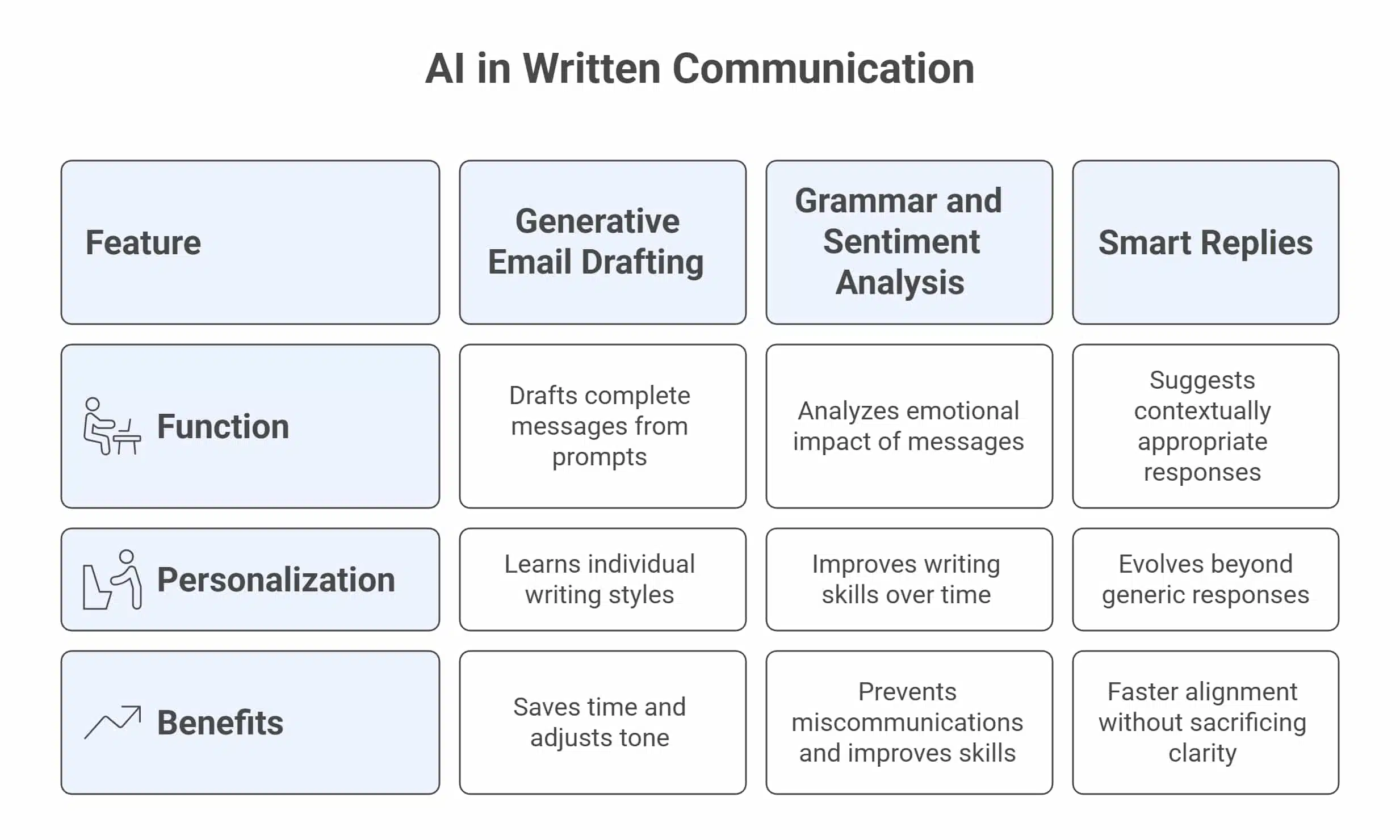
The New Era of Written Communication
Email remains the primary business communication channel, with professionals sending and receiving an average of 126 messages daily. AI is transforming how we write, review, and respond.
Generative Email Drafting
AI email writing tools integrated into Gmail, Outlook, and other platforms now draft complete messages from brief prompts. Type “Schedule a follow-up meeting to discuss the Q4 budget” and AI generates a professional email with appropriate tone, context, and formatting.
These systems learn individual writing styles over time, producing drafts that sound authentically like you rather than generic corporate-speak. The time savings compound dramatically—what took ten minutes now takes two.
Tone adjustment features let you transform the same message for different audiences. The same update becomes casual for teammates, formal for executives, or friendly for external partners with a single click.
Grammar and Sentiment Analysis
Tools like Grammarly Go move far beyond spell-checking to analyze the emotional impact of messages before you send them. They flag language that might be perceived as aggressive, passive-aggressive, or dismissive—helping prevent the miscommunications that plague remote work.
This real-time coaching improves writing skills over time rather than replacing them. Writers see suggestions with explanations, gradually internalizing better communication patterns.
Smart Replies That Learn
Slack and Microsoft Teams now offer AI-powered smart replies that suggest contextually appropriate responses. These evolve beyond the generic “Sounds good!” to understand conversation context and suggest substantive replies that maintain discussion momentum.
The result is faster internal alignment without sacrificing thoughtfulness or clarity.
Customer-Facing Communication: Hyper-Personalization
Customer expectations have shifted dramatically. They expect instant responses, personalized interactions, and resolution without repeating information multiple times.
The Evolution Beyond Basic Chatbots
Early chatbots followed rigid decision trees, frustrating customers with inflexible “I didn’t understand that” responses. Modern conversational AI using natural language processing understands intent and context, holding genuinely helpful conversations.
These systems recognize that “Where’s my order?”, “I haven’t received my package,” and “Track my shipment” all express the same underlying need, routing customers to appropriate information regardless of phrasing.
The difference between rule-based bots and NLP-powered systems is the difference between frustration and satisfaction.
Real-Time Sentiment Analysis
AI listening to customer service calls analyzes vocal tone and word choice to detect rising frustration in real-time. When sentiment turns negative, the system prompts agents with de-escalation scripts proven effective for similar situations.
This coaching elevates every agent to expert-level crisis management, preventing small frustrations from becoming complaints or cancellations.
Always-On Availability
Modern customers expect businesses to be available whenever they need help—not just during business hours. AI agents fill this gap, handling routine inquiries at 2 AM with the same expertise as 2 PM.
Research shows that 40 percent of customers who reach voicemail never call back, taking their business to competitors who answer immediately. AI eliminates this revenue leakage entirely.
Non-Verbal Communication and Emotional Intelligence
The most sophisticated AI now analyzes what isn’t said—the subtle cues in voice tone, speech patterns, and facial expressions that reveal true sentiment.
Voice and Facial Analysis for Sales
Emerging technology analyzes vocal pitch, speaking pace, and facial micro-expressions during sales calls to determine prospect engagement and interest level. Real-time dashboards show sales representatives whether prospects are genuinely interested or just being polite.
This feedback transforms sales training. Representatives receive immediate coaching: “You’re speaking too quickly—slow down to build trust” or “The prospect’s tone suggests skepticism—address their concerns directly.”
While ethically complex, these tools dramatically improve conversion rates by helping sellers read digital rooms as effectively as in-person meetings.
The Challenges: Maintaining the Human Element
AI’s power creates risks that organizations must actively manage.
The Uncanny Valley of Generated Text
Over-reliance on AI-generated responses creates communication that feels hollow and robotic despite grammatical perfection. Customers and colleagues sense something missing the authentic human voice that builds real connection.
The solution isn’t avoiding AI but using it thoughtfully. Let AI draft and edit, but inject personal touches, relevant examples, and genuine personality before sending.
Data Privacy and Security Concerns
Feeding sensitive business strategy into public AI models like ChatGPT creates data leakage risks. Competitors could theoretically access information, or proprietary strategies could appear in responses to other users.
Organizations need clear policies about what information employees can and cannot share with external AI tools, plus investment in enterprise AI solutions with proper data governance.
The Skills Atrophy Problem
Junior employees learning to write and think by observing AI-generated text may never develop the critical thinking and communication skills that senior leaders possess. Organizations must balance efficiency gains against the long-term need for humans who can think and communicate independently.
Future Trends: What’s Coming Next
Digital Twins and AI Avatars
The next evolution creates AI avatars that attend meetings on your behalf, present information using your voice and mannerisms, and answer routine questions based on your knowledge base. You review and approve before your avatar acts, but you’re freed from repetitive presentation tasks.
Multimodal AI Systems
Future communication platforms will seamlessly switch between text, voice, and video generation in single interactions. Start a conversation typing, continue it speaking, and have AI generate video explanations of complex concepts—all within one flow.
The Path Forward
AI in business communication delivers undeniable benefits: speed, clarity, inclusivity, and scale impossible with purely human systems. Teams collaborate across languages and time zones. Meetings become productive rather than draining. Customer service never sleeps.
But technology remains a tool, not a replacement for genuine human connection. The goal of communication hasn’t changed—it’s still about creating understanding, building relationships, and coordinating action toward shared goals.
The organizations that thrive will be those that use AI to remove friction and amplify human capabilities rather than replacing the judgment, creativity, and empathy that only people provide.
Take Action Today
Ready to future-proof your business communication? Start with an audit of your current stack:
Which repetitive communication tasks consume the most time? Those are prime automation candidates. Where do language barriers or time zones create collaboration friction? Implement translation and asynchronous tools. Which customer inquiries could AI handle without human intervention? Deploy conversational AI for those scenarios.
The future of work communication is already here. The only question is how quickly you’ll embrace it.


