

Here’s the uncomfortable truth that keeps dental practice owners up at night: you could be the best dentist in Miami, with state-of-the-art equipment and a chair-side manner that puts patients at ease, but if your Google reviews don’t reflect that excellence, you’re invisible to new patients searching online. The paradox is real and frustrating. Most successful dental practices have hundreds of satisfied patients walking out their doors each month, yet their Google profile shows only a handful of reviews. Meanwhile, that competitor down the street with mediocre service but 200+ recent reviews is capturing all the new patient calls.
The problem runs deeper than simple neglect. Research consistently shows that unhappy patients are three times more likely to leave a review without any prompting compared to satisfied ones. It’s human nature—we’re wired to share negative experiences as a form of warning to others. This creates what I call the “vocal minority issue” where your online reputation becomes skewed toward the rare bad experience rather than reflecting the hundreds of positive ones.
- The Google Map Pack reality: When someone searches “dentist near me” in Miami, only the top 3 results appear in that coveted map section, and Google’s algorithm heavily weighs review frequency, recency, and overall star rating
- The visibility gap: Practices with 50+ reviews and consistent recent activity rank significantly higher than those with better technical SEO but stagnant review profiles
- The conversion factor: 87% of consumers read online reviews before choosing a local business, and 73% only pay attention to reviews written in the last month
- The solution shift: Moving from passive collection (hoping patients remember to review you) to proactive AI automation that systematically captures feedback
What Does “AI Automation” Actually Mean for a Dental Practice?
Let’s clear up the confusion right away—AI review automation isn’t just setting up a generic email blast that goes out to everyone who walks through your door. That’s 2010 technology dressed up with a buzzword. True AI automation for dental practices means creating an intelligent system that integrates directly with your existing practice management software and makes smart decisions about when, how, and who to ask for reviews. It’s the difference between broadcasting the same message to everyone and having a thoughtful conversation tailored to each patient’s specific experience.
The magic happens in what’s called the integration layer. Modern AI platforms connect through APIs (Application Programming Interfaces) to practice management systems like Dentrix, Open Dental, Eaglesoft, or Curve Dental. Once connected, the AI can see appointment types, patient histories, and treatment outcomes without any manual data entry from your staff. This creates a seamless flow where your normal office operations automatically trigger the review request process.
- The trigger event setup: The system activates based on specific status changes in your PMS, such as when a patient is marked as “Checked Out” or when their appointment is marked “Complete”
- Zero manual work required: Once configured, the entire process runs in the background without your front desk lifting a finger
- Data synchronization: Patient contact information, appointment details, and provider names automatically populate into personalized messages
- HIPAA-compliant infrastructure: Reputable platforms maintain proper security protocols and Business Associate Agreements to protect patient information
The 4 Pillars of AI Review Automation
A. Intelligent Timing & “The Golden Window”
Timing isn’t just important—it’s everything when it comes to review requests. Send the text too soon and the patient is still numb from anesthesia. Send it too late and they’ve completely moved on with their life and forgotten about their appointment. AI solves this through what I call “The Golden Window”—that perfect moment when the patient feels great about their visit but hasn’t yet been buried by work emails and family obligations.
The AI analyzes the appointment time and type to calculate optimal send times. If someone had a routine cleaning at 9 AM, the system might send a text around lunchtime when they’re taking a break. For a late afternoon crown preparation, it intelligently waits until the next morning when any residual discomfort has subsided. This isn’t random—it’s based on behavioral data showing when patients are most likely to engage.
- Morning appointments: Review requests typically sent 3-4 hours later during lunch breaks
- Afternoon procedures: Messages delayed until the following morning to avoid catching patients during dinner rush
- Weekend visits: Smart scheduling pushes requests to Monday morning when response rates are higher
- Procedure-specific delays: More invasive treatments get longer waiting periods before the ask
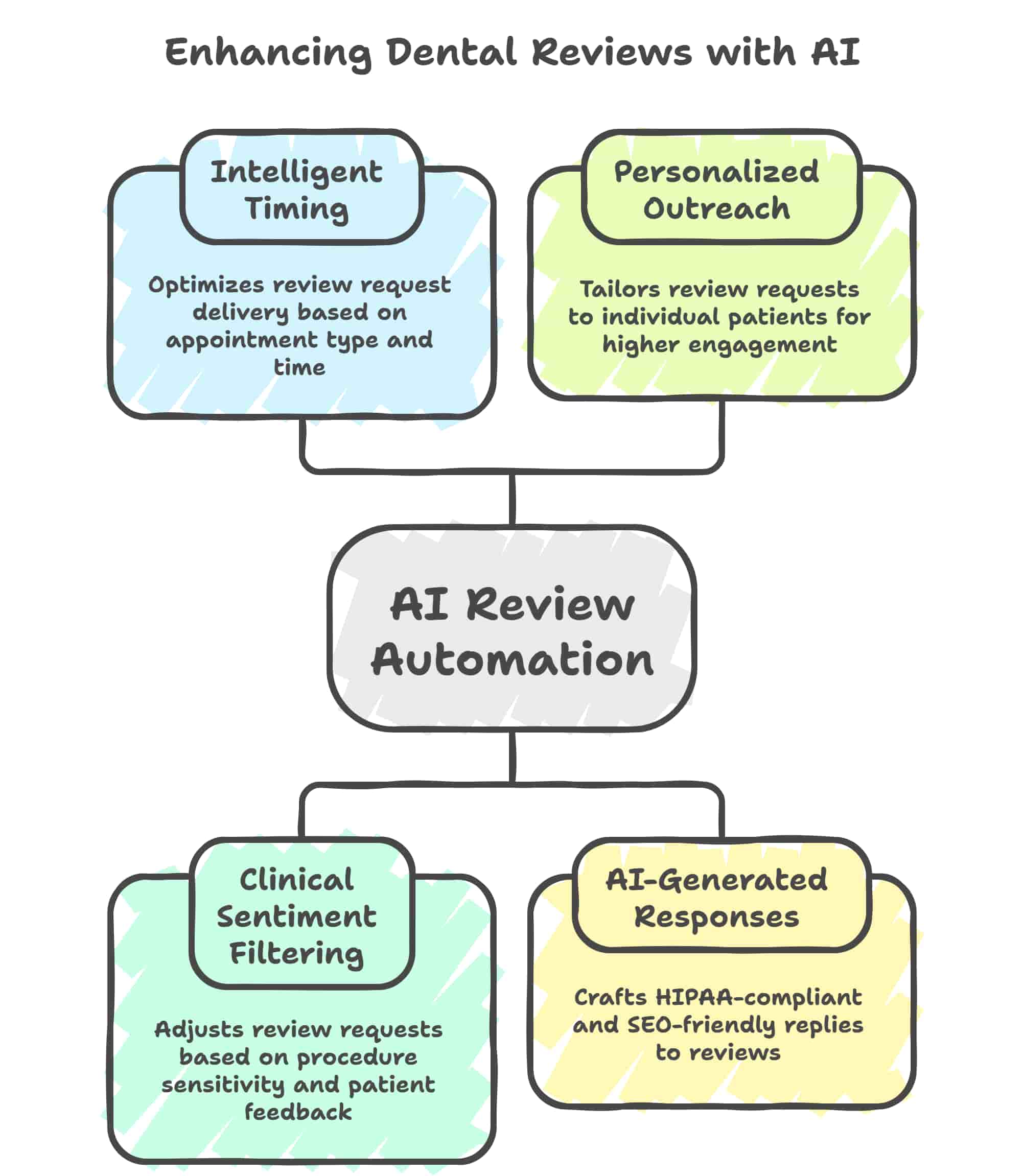
B. Clinical Sentiment Filtering (The Safety Net)
This is where AI automation separates itself from dumb batch-and-blast systems. Not all dental procedures are created equal, and asking for a review immediately after a painful root canal is a recipe for disaster. Smart AI platforms allow you to create rules based on procedure codes in your PMS, automatically adjusting the approach based on what treatment the patient received.
For routine preventive care like cleanings, exams, and whitening, the automation can run at full speed with immediate requests. But for procedures that might leave patients uncomfortable—extractions, root canals, surgical implant placements—the system can introduce delays, require manual approval from your office manager, or skip the automation entirely. Even more sophisticated is the internal feedback loop: when patients indicate dissatisfaction by clicking a low rating in the initial text, the AI redirects them to a private feedback form instead of your public Google profile.
- Procedure code mapping: Define which CPT/CDT codes trigger immediate requests vs. delayed or manual review
- Negative review prevention: Low ratings captured privately allow your team to address concerns before they go public
- Office manager alerts: Automated notifications when a patient submits critical feedback through the private channel
- Second-chance campaigns: Follow-up with previously dissatisfied patients after their concerns have been resolved
C. Personalized Outreach at Scale
Generic review requests have dismal response rates because they feel like spam. The power of AI comes from its ability to personalize at scale—making each of your 500 monthly patients feel like you crafted a message specifically for them. The system pulls dynamic fields from your PMS including the patient’s first name, the specific provider they saw, and the exact procedure performed.
Instead of “Please leave us a review,” imagine sending: “Hi Sarah, how does your new smile feel after your whitening session with Dr. Smith yesterday? We’d love to hear about your experience!” That level of personalization dramatically increases engagement because it demonstrates you actually remember their visit and care about their specific outcome.
- Multi-channel sequencing: Start with SMS (highest open rate), automatically follow up via email if no response within 3 days
- Provider-specific requests: Patients review the actual dentist or hygienist they saw, creating more authentic testimonials
- Treatment-specific language: Different message templates for cosmetic procedures vs. restorative vs. preventive care
- Response rate optimization: AI tracks which message variations perform best and continuously improves
D. AI-Generated Review Responses (HIPAA Compliant)
Getting reviews is only half the battle—responding to them is equally critical for SEO. Google’s algorithm rewards businesses that actively engage with their reviews, and potential patients read your responses to gauge how you handle feedback. But manually crafting thoughtful responses to every review becomes a massive time drain as your volume increases. AI can draft responses that sound genuine, incorporate relevant keywords for SEO, and maintain HIPAA compliance by never confirming specific treatment details.
The system can generate responses that thank patients by name, reference the general service category (like “glad you were happy with your cosmetic consultation”), and invite them back—all while staying within legal boundaries. Your team simply reviews and approves before posting.
- SEO keyword integration: Responses naturally include search terms like “dental implants,” “teeth whitening,” or “emergency dentist”
- HIPAA guardrails: AI trained never to confirm medical details or treatment specifics in public responses
- Tone consistency: Responses match your practice’s brand voice whether that’s professional, warm, or community-focused
- Time savings: Reduces response drafting from 10 minutes per review to 30 seconds of approval
The Bottom Line
AI-powered review automation isn’t about gaming the system—it’s about systematically capturing the authentic positive experiences that already exist in your practice but currently go unshared. In Miami’s competitive dental market, this technology has become the difference between practices that thrive and those that struggle to fill their schedules. The dentists winning new patient searches aren’t necessarily better clinicians; they’re simply better at showcasing their excellence through consistent, recent reviews. The question isn’t whether to implement AI automation anymore it’s how quickly you can get it running to protect your practice’s competitive position.


