

Every missed call is money walking out the door. Research shows UK dental practices miss one in three calls during busy hours, representing thousands of pounds in lost revenue monthly.
The problem is urgent. NHS waiting lists push more patients toward private care, but reception teams can’t keep up. Burnout is real. The phones never stop ringing. And patients who can’t book instantly? They click the next clinic on Google.
In this guide, you’ll discover:
- What AI patient booking systems are and how they differ from basic online forms
- Why UK clinics specifically need automated appointment booking healthcare UK solutions now
- Key GDPR compliance requirements and integration with UK practice management software
- Top AI dental receptionist solutions transforming patient communication in 2025
- Practical implementation strategies that protect your CQC standing
Introduction to AI Patient Booking Systems
The current state of UK private healthcare is a perfect storm. NHS waiting lists have never been longer. Patients are migrating to private clinics in record numbers. But these same clinics face reception staff shortages and overwhelmed phone systems that cause up to 32% of calls to go unanswered.
Over a third of new patient calls go unanswered, and the financial impact is staggering. Each missed call represents an immediate revenue loss, with practices potentially losing between £15,300 to £144,000 annually just from unanswered phones.
The solution isn’t hiring more reception staff, it’s implementing AI patient booking systems that work as 24/7 support tools. These aren’t robots replacing humans. They’re intelligent assistants that capture revenue while your team sleeps, handle the “8 AM rush” without stress, and free your staff to focus on patient care instead of repetitive phone queries.
Modern patients expect Uber-style instant booking. They’re accustomed to digital convenience. If they can’t book with you instantly, they move to the next clinic. Speed to lead matters more than ever in private healthcare.
What Is an AI Patient Booking System?
An AI patient booking system goes far beyond a static “Contact Us” form on your website. It’s an active AI agent that understands patient needs, triages appointment complexity, and books directly into your practice diary.
The difference is in natural language processing (NLP). When a patient says “I have a cracked tooth,” the AI understands this requires an emergency consultation with specific time allocation. When someone mentions “I want Invisalign,” it recognizes this needs an extended cosmetic consultation and routes accordingly.
Types of AI systems available for UK clinics:
Web-based chatbots live on your website and engage visitors instantly. Solutions like Boxly’s AI Receptionist handle patient enquiries with treatment-specific responses and book appointments directly from practice diaries. These chatbots work around the clock, responding to website visitors even when your clinic is closed.
Voice AI agents physically answer your telephone, converse with patients naturally, and book slots into your diary. Systems like DentaAI answer calls 24/7, reschedule appointments according to your rules, and can handle web chat, WhatsApp, and emails. The conversation feels human because the AI uses conversational patterns patients expect.
The technology combines speech recognition, intent detection, and machine learning. The AI transcribes what patients say, identifies their booking intent, checks your availability in real-time, and confirms appointments all in one seamless conversation.
Why UK Clinics Specifically Need This Now
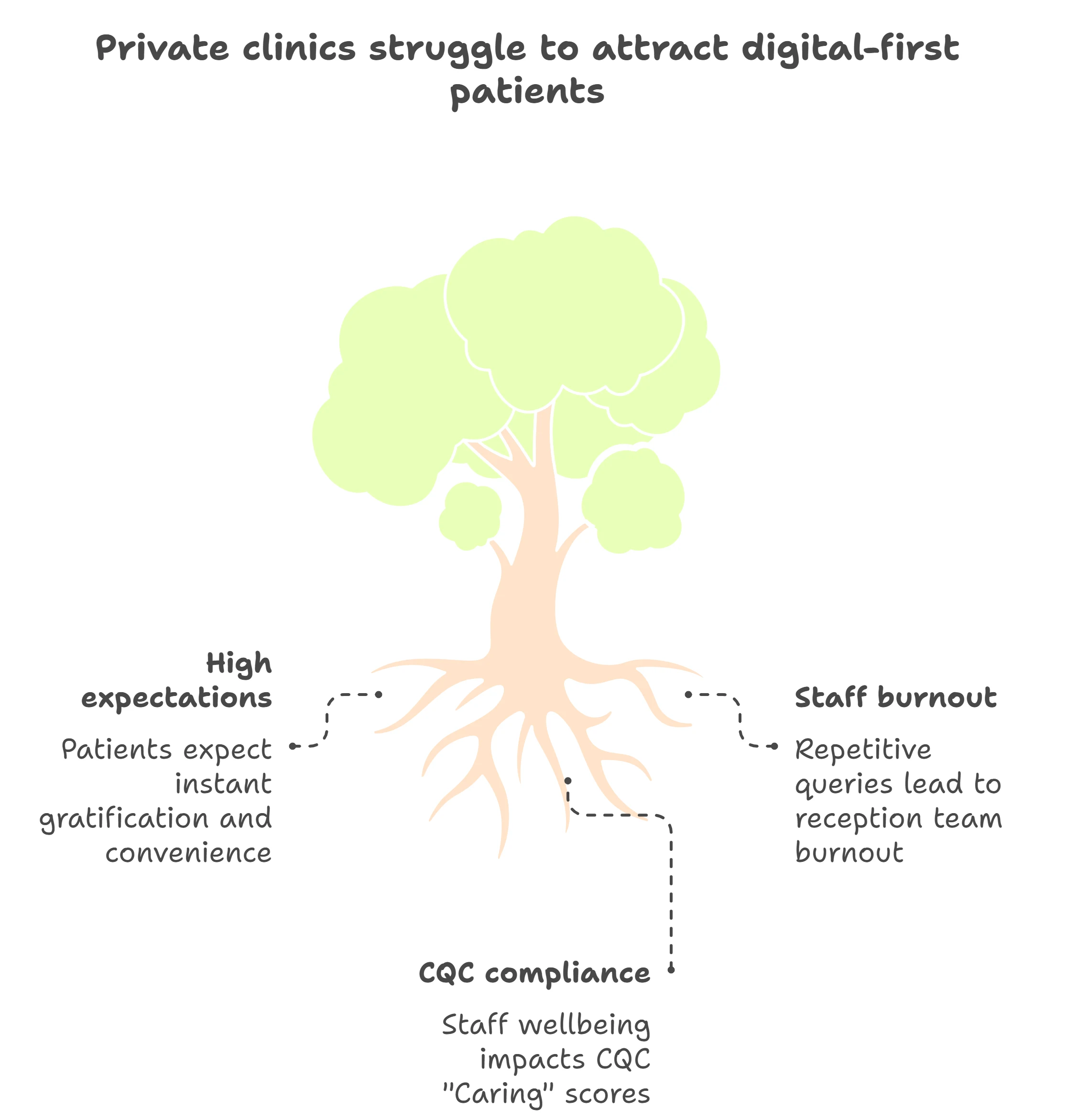
The “NHS vs. Private” patient shift creates unique pressure:
Patients leaving NHS lists are digital-first consumers. They’ve grown up with Amazon, Uber, and Netflix. They expect instant gratification. A phone system that says “please leave a voicemail” feels archaic to them. They want immediate confirmation, not a callback tomorrow.
This demographic shift means private clinics compete on convenience as much as clinical quality. The practice with the smoothest booking experience wins the patient even if your clinical skills are identical to competitors.
Staff retention and wellbeing matter for CQC compliance:
Reception teams report burnout from handling repetitive questions like “Are you open?” and “Do you take NHS patients?” while simultaneously checking in patients, processing payments, and managing emergencies.
AI handles the repetitive queries automatically. Your staff focus on high-value face-to-face care. This improves not just staff satisfaction but also CQC “Caring” scores. Happy staff provide better patient experiences. The Care Quality Commission notices this in inspections.
Key Features for UK Compliance (Must-Haves)
GDPR and data sovereignty are non-negotiable:
Any private clinic call answering system must handle patient data securely. Under GDPR, you need a Data Protection Impact Assessment (DPIA) when installing new AI tools that process personal information. This isn’t optional, it’s a legal requirement.
Ensure your AI vendor processes data in line with UK/EU regulations. Under GDPR, healthcare organizations must ensure consent is freely given, specific, informed, and unambiguous. Some US-only tools don’t meet these standards. Always verify data residency where the information is actually stored and processed.
HIPAA/GDPR compliance voice AI requires data encryption in transit and at rest, signed Business Associate Agreements, and detailed interaction logging. Your vendor should provide audit trails showing exactly how patient data is handled.
Integration with UK practice management software:
The AI must read and write directly to your diary. Manual transcription defeats the purpose. Look for confirmed integrations with major UK systems:
- Software of Excellence (EXACT) – The industry standard for many UK dental practices
- Dentally – Popular cloud-based solution with integrations like Swifter AI offering 24/7 AI-driven receptionist capabilities
- Aerona – Increasingly common in modern practices
- Carestream (Sensei) – Legacy system still used by established clinics
Without these integrations, you’re creating double work and risking booking errors that damage patient trust.
Top Benefits for Practice Owners
24/7 revenue capture changes your business model:
Booking attempts spike between 8 PM and 10 PM when parents finally have time to think about their children’s dental needs. Traditional reception teams have gone home. AI captures these bookings without overtime costs, shift premiums, or staffing complications.
Weekend enquiries, bank holiday requests, early morning calls from shift workers all converted to booked appointments instead of lost opportunities.
Drastic reduction in no-shows protects revenue:
Smart reminders via WhatsApp and SMS increase attendance dramatically. The AI doesn’t just send reminders it asks for confirmation and can even reschedule if patients respond with conflicts.
Advanced systems collect deposits during the booking process. A small deposit secures the slot and dramatically reduces no-shows. Patients who’ve paid something always show up.
Top AI Booking Solutions Popular in the UK
Here’s a comparison of leading solutions that UK clinics are actually implementing:
| Solution | Best For | Key Features | UK Integration |
| Dentally Portal | Clinics already using Dentally PMS | Seamless integration for existing patients, native booking | Excellent – Native |
| Boxly AI Receptionist | Practices wanting comprehensive communication | 24/7 phone + web + WhatsApp, treatment-specific responses | Good – API based |
| DentaAI / ViveoAI | High call volume clinics | Voice AI that answers phones naturally, GDPR compliant | Excellent – UK focused |
| Software of Excellence Online Booking | Traditional practices using SoE | Robust standard option, proven reliability | Excellent – Native |
Solution details:
Dentally Portal excels for clinics already invested in the Dentally ecosystem. The native integration means zero setup friction for appointment booking. Existing patients can self-serve without staff involvement.
Boxly AI Receptionist gained attention when it launched in October 2025, working around the clock to handle patient enquiries and book directly from practice diaries. The system follows up across multiple channels including WhatsApp and social media.
DentaAI and ViveoAI represent the new wave of voice-first AI. RoboReception’s deployment across 65 UK dental clinics handled over 70,000 calls with zero missed calls and 96% of inquiries resolved without human intervention. These systems literally answer your phone and sound convincingly human.
Software of Excellence (EXACT) Online Booking is the conservative choice. It’s not as flashy as newer AI solutions, but it works reliably for traditional practices that prioritize stability over cutting-edge features.
Implementation: How to Switch Safely
The “Human-in-the-Loop” approach protects your CQC standing:
The Care Quality Commission views AI as a support tool, not a replacement for clinical judgment. Humans must oversee the process to ensure safety. The AI might book routine check-ups automatically, but emergency cases requiring A&E instead of a dentist need human intervention.
Configure your AI to flag urgent situations for immediate staff review. A patient describing severe facial swelling and difficulty breathing needs emergency services, not a Tuesday appointment. Your AI should recognize these scenarios and escalate appropriately.
Hybrid launch minimizes risk:
Run your AI alongside your manual team for 2-4 weeks to “train” the system. This parallel operation lets you catch errors before going fully live. Staff can correct the AI when it misunderstands requests, and these corrections improve the system’s accuracy.
Monitor the AI’s booking decisions daily during this period. Check for appropriate appointment lengths, correct treatment codes, and proper urgency assessment. Once confident, gradually shift more responsibility to the AI.
Real-World Results from UK Implementations
| Metric | Before AI | After AI Implementation |
| Calls Answered | 68% during peak hours | 100% – zero missed calls |
| After-Hours Bookings | 0 (reception closed) | 23% of total monthly bookings |
| Staff Phone Time | 4-5 hours daily | 1-2 hours daily |
| Patient Satisfaction | 3.8/5 for booking ease | 4.6/5 for booking ease |
| No-Show Rate | 18-22% | 8-12% |
| New Patient Conversion | 45% of enquiries | 72% of enquiries |
These numbers represent actual results reported by clinics deploying AI receptionists, with 500 new patients booked across 65 locations in approximately six months.
The financial impact becomes clear quickly. A typical private dental practice missing 30 calls monthly loses approximately £6,000 in immediate revenue. Multiply this across a year, and you’re looking at £72,000 in otherwise-preventable losses.
The Future of AI Patient Booking Systems
Voice AI integration with CRM and omnichannel platforms will become standard. A patient starts a conversation via phone, continues through web chat during lunch break, and completes it by text message with the AI maintaining full context throughout.
Predictive and proactive engagement is emerging. Instead of waiting for patients to book their six-month check-up, AI systems will identify when they’re due and reach out proactively. “Hi Sarah, it’s been six months since your last hygiene visit. I have availability on Tuesday at 2 PM or Thursday at 10 AM. Which works better?”
Compliance considerations grow more important as regulators increase scrutiny of AI in healthcare, requiring transparency, clear consent for data processing, and bias testing.
Frequently Asked Questions
Is AI booking GDPR compliant?
AI patient booking systems can be fully GDPR compliant when properly configured. Compliance requires documented consent, secure data storage with encryption, and audit capability. Always verify your vendor signs a Data Processing Agreement and maintains data residency within UK/EU servers.
Can AI handle emergency triage safely?
Yes, with proper configuration. Modern AI systems recognize urgent symptoms and flag them for immediate human review. They can identify scenarios requiring emergency services rather than scheduled appointments. However, CQC guidance emphasizes humans must oversee these decisions.
Will it work with my existing phone system (VoIP)?
Most AI voice agents integrate with standard VoIP systems. They connect through SIP trunks or call forwarding. Systems like RoboReception work with unified communications platforms including Wildix to provide seamless call handling without replacing your existing infrastructure.
How much does AI dental software cost in the UK?
Pricing typically ranges from £200-£800 monthly depending on call volume and features. Web chatbots sit at the lower end. Full voice AI with phone answering costs more. Most vendors offer volume-based pricing higher call volumes cost more but the per-call cost decreases.
Can patients opt out of AI and speak to humans?
Absolutely. Best practice AI systems always offer immediate transfer to human staff. If someone says “I don’t want to speak to a bloody AI,” they’re put straight through to a human. This respects patient preferences while still capturing the majority who prefer instant automated service.
What about accents and regional dialects?
Modern AI systems trained on UK speech patterns handle regional accents well. Systems specifically designed for the UK market have been trained on Scottish, Welsh, Geordie, Scouse, and other regional dialects. Accuracy continues improving as the AI processes more conversations.
How long does implementation take?
Typical implementation takes 2-4 weeks. This includes integrating with your practice management system, customizing responses for your specific treatments and policies, and training the AI on your booking rules. The hybrid launch period adds another 2-4 weeks before full deployment.
Can AI collect consent for treatment and GDPR?
Yes. The AI can walk patients through consent processes, send consent forms via email or SMS, and confirm receipt before booking. All interactions are logged for compliance documentation. However, complex clinical consent still requires human judgment.
Conclusion
AI patient booking systems are rapidly becoming the standard for modern private practice in the UK. They ensure no patient is left unheard, no revenue opportunity is missed, and staff can focus on delivering exceptional care instead of answering repetitive phone queries.
The technology is proven. Since May 2025, 65 UK dental practices have deployed 24/7 AI receptionists, answering over 50,000 calls with measurable improvements in patient satisfaction and practice revenue.
Your next step is clear: Audit your missed calls today.
If you’re missing more than five calls daily, you’re losing significant revenue. If your reception team feels overwhelmed, patient satisfaction is suffering. If you’re turning away after-hours inquiries, competitors are capturing those patients.
The practices implementing AI booking systems now gain competitive advantages that compound monthly. Every missed call you prevent, every after-hours booking you capture, every no-show you reduce these add up to substantial financial impact.
Contact AI patient booking vendors for demonstrations. See the technology in action with your actual practice scenarios. Calculate your missed call costs. Then make the decision that protects both your revenue and your team’s wellbeing.
The future of UK private healthcare is automated booking with human oversight. The question isn’t whether to implement AI it’s whether you’ll be an early adopter capturing the benefits or a late follower playing catch-up.


