

Customer expectations have changed. Nobody wants to press buttons anymore.
They want answers fast, personal, and without the frustration of navigating endless phone menus. That’s where the conversation around AI agents and IVR systems becomes critical for businesses trying to stay competitive.
In this guide, you’ll discover:
- What IVR systems are and how they’ve dominated customer service for decades
- How AI voice agents use natural language processing to transform caller experiences
- Side-by-side comparison of AI agents vs IVR technology, capabilities, and costs
- Practical decision framework to choose the right solution for your business needs
Introduction to AI Agents and IVR Systems
Customer communication automation isn’t optional anymore. It’s essential for businesses that want to scale without drowning in operational costs or losing customers to poor service experiences.
Traditional IVR (Interactive Voice Response) systems have handled billions of customer calls since the 1980s. They’re reliable, predictable, and cost-effective for routing simple inquiries. But they’re also rigid, frustrating, and increasingly inadequate for today’s customer expectations.
AI voice agents represent the evolution of this technology. Instead of forcing callers through menu trees, they understand natural speech, detect intent, and hold actual conversations. They learn from interactions, adapt to contexts, and resolve issues that would have required human intervention just a few years ago.
This guide breaks down both technologies without the marketing hype. You’ll understand what each system does well, where they fall short, and how to make the right choice for your specific business situation.
What Is IVR and How Does It Work?
IVR stands for Interactive Voice Response. It’s a telephony technology that allows callers to interact with an automated system using voice commands or keypad inputs before reaching a human agent.
When you call a business and hear “Press 1 for Sales, Press 2 for Support,” you’re interacting with an IVR system. The technology captures your input, follows pre-programmed logic trees, and routes your call accordingly.
The system answers the incoming call and plays a recorded greeting or menu. Callers respond by pressing numbers on their keypad or speaking simple commands. The IVR processes this input and either provides pre-recorded information, routes the call to the appropriate department, or collects data like account numbers before transferring to an agent.
Common IVR use cases include call routing and directory services, account balance inquiries, appointment confirmations and reminders, payment processing, and queue management during high call volumes.
Traditional IVR has significant limitations:
Callers get frustrated navigating multiple menu levels. IVR can’t handle complex questions or unexpected requests. It lacks context awareness each interaction starts from zero. The experience feels robotic and impersonal. Many callers simply press zero repeatedly to bypass the system entirely, defeating its purpose.
What Is an AI Voice Agent?
An AI voice agent is an intelligent system that uses artificial intelligence to conduct natural, human-like conversations over the phone. Unlike traditional IVR, which follows rigid scripts, AI agents understand intent, context, and conversational nuances.
These systems combine several advanced technologies. Natural language processing (NLP) allows them to comprehend what callers actually mean, not just the specific words they say. Speech recognition converts spoken words into text. Intent detection identifies what the caller wants to accomplish. Machine learning enables the system to improve over time.
When a caller speaks, the AI agent transcribes and analyzes the speech in real-time. It identifies the caller’s intent and generates an appropriate response using natural language generation. The conversation flows naturally. The caller can interrupt, change topics, or ask follow-up questions. The AI maintains context throughout the interaction.
AI voice agents can handle complex, multi-turn conversations that would overwhelm traditional IVR. They recognize when they’re out of their depth and smoothly transfer to human agents with full context about what’s been discussed.
AI Agent and IVR: Side-by-Side Comparison
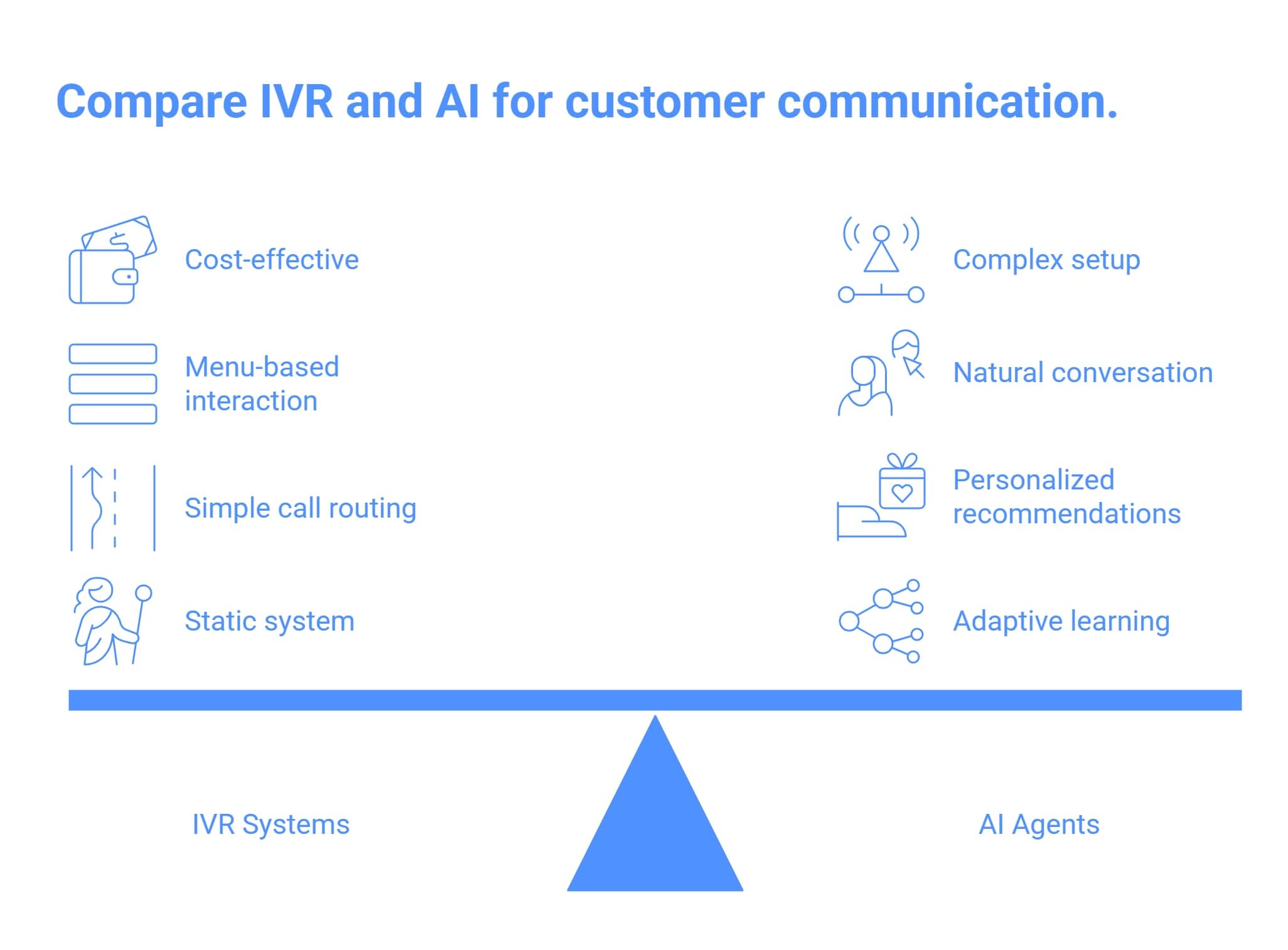
Understanding the practical differences between these technologies helps you make informed decisions about your customer communication infrastructure.
Technology
IVR systems operate on rule-based logic. Programmers create decision trees mapping every possible path a caller might take. The system can only respond to scenarios explicitly programmed into it.
AI agents use machine learning models trained on vast amounts of conversational data. They understand language patterns, detect intent, and generate contextually appropriate responses. These models continuously improve as they process more conversations.
IVR systems remain static until a developer updates the code. AI agents learn from interactions and adapt without constant human intervention.
User Interaction
IVR forces menu-based interactions. Callers must listen to options, remember menu structures, and provide input in specific formats.
AI agents enable natural conversation. Callers simply speak as they would to a human. “I need to reschedule my appointment for next Tuesday” works without breaking it into menu selections.
With IVR, callers often feel frustrated by rigid menus and unclear options. With AI agents, callers experience fluid conversations that feel efficient and respectful of their time.
Capabilities
Traditional IVR handles call routing effectively. It can answer simple FAQs with pre-recorded messages. It collects information like account numbers. It can process simple transactions like payments when integrated with backend systems.
AI agents do all of that plus significantly more. They handle booking and scheduling with natural date/time understanding. They troubleshoot problems by asking diagnostic questions. They provide personalized recommendations based on caller history. They handle complaints with empathy-appropriate responses.
The critical difference lies in context awareness. IVR treats each menu selection as an isolated event. AI agents maintain conversational context across the entire interaction.
Strengths and Weaknesses
IVR strengths:
Cost-effectiveness is clear. IVR systems have lower upfront costs and minimal ongoing expenses. Simplicity makes them easy to implement for straightforward call routing. Reliability means they perform consistently without unexpected behaviours.
AI agent advantages:
Personalization transforms the customer experience. The system adapts responses based on caller history and context. Scalability allows handling complex inquiries that would require extensive IVR menu trees. Natural conversation reduces caller frustration and abandonment.
IVR limitations:
IVR fails with complex queries. When customer needs don’t fit menu options, the system can’t adapt. The rigid structure frustrates callers trying to accomplish tasks outside predefined paths.
AI agent challenges:
Setup complexity requires more sophisticated implementation. Initial costs typically run higher than traditional IVR. Systems may occasionally misunderstand intent, especially with accents or unclear speech.
IVR vs AI Agent: Key Differences at a Glance
Decision-makers need quick comparisons to evaluate which technology fits their needs. This table summarizes the core differences:
| Feature | Traditional IVR | AI Voice Agent |
| Interaction Style | Menu-based navigation, keypad inputs | Natural conversation, free-form speech |
| Automation Level | Handles simple, predefined tasks | Resolves complex, varied inquiries |
| Flexibility | Rigid paths, requires programming for changes | Adapts to new questions, learns over time |
| Setup Cost | Lower initial investment | Higher initial investment |
| Customer Experience | Often frustrating for complex needs | Generally positive, feels human-like |
| Context Awareness | None each interaction is isolated | Maintains context throughout conversation |
| Personalization | Minimal same experience for everyone | High adapts to individual caller history |
AI Agent, IVR, or Hybrid: What’s Best for Your Business?
The right choice depends on multiple factors specific to your situation.
Budget and Call Volume
Small businesses with limited budgets and modest call volumes (under 1,000 calls monthly) often find traditional IVR sufficient. The cost-effectiveness and simplicity make sense when inquiries are straightforward.
Medium-sized businesses (1,000-10,000 calls monthly) benefit significantly from AI voice agents. The volume justifies the investment, and the complexity of inquiries typically exceeds what IVR handles well.
Enterprise-level organizations (10,000+ calls monthly) almost always benefit from AI solutions. At scale, even small improvements in resolution rates translate to substantial financial impact.
Complexity of Inquiries
Simple routing scenarios favor IVR. If 90% of your calls fit cleanly into three or four categories, IVR works efficiently.
Complex conversations demand AI agents. When customers call with unique situations, multi-part questions, or problems requiring diagnosis, menu-based systems fail.
The tipping point typically occurs when more than 30% of callers require human intervention after IVR interaction.
Customer Experience Goals
If your company differentiates on customer experience, AI agents align with that positioning. They signal that you respect customers’ time and invest in convenient service.
Industries with high customer expectations banking, healthcare, premium retail face pressure to provide seamless experiences. Frustrated customers encountering clunky IVR systems develop negative associations with your brand.
When a Hybrid Approach Makes Sense
Many businesses find optimal results combining both technologies. Use IVR for initial routing while leveraging AI for actual conversations.
Callers first encounter a simple IVR that identifies the general department or service area they need. Once routed to the appropriate area, an AI agent takes over for the actual conversation.
This hybrid approach provides several advantages. It reduces the load on expensive AI systems by handling simple routing with cheap IVR. It maintains the reliability of IVR for the one thing it does well. It delivers the superior customer experience of AI where it matters most.
Real-World Case Studies
Here’s what businesses actually experience implementing these technologies:
| Company | Problem | Solution | Results |
| Scripbox (Wealth Management) | High call volume, low first-call resolution, IVR couldn’t handle complex financial inquiries | AI voice agent layered over existing IVR, trained on financial conversations | 40% reduction in human agent load, faster resolution times, improved customer satisfaction, 24/7 service availability |
| University of Ottawa Heart Institute | Thousands of appointment calls monthly, long wait times, staff overwhelmed with scheduling | Conversational AI agent for appointment management integrated with scheduling software | 80% of scheduling calls automated, wait times dropped from 10-15 minutes to under 2 minutes, improved patient satisfaction, staff redeployed to clinical support |
These examples demonstrate measurable ROI from implementing AI voice agents in scenarios where traditional IVR couldn’t meet customer needs.
The Future of AI Agents and IVR
The trajectory is clear. Customer communication is shifting from menu-based systems to conversational AI, though the transition will take years.
Voice AI integration with CRM systems and omnichannel platforms creates seamless customer experiences. A caller can start a conversation via phone, continue it through web chat, and complete it by text message with full context maintained throughout.
Predictive and proactive customer engagement represents the next evolution. Instead of waiting for customers to call with problems, AI systems will identify issues proactively and reach out. “We noticed your order hasn’t shipped yet due to an inventory delay. Would you like us to expedite shipping or choose an alternative product?”
As AI agents handle sensitive customer data, compliance becomes critical. Businesses must ensure transparency about AI usage, clear consent for data processing, accurate record-keeping, and bias testing to ensure fair treatment.
FAQs About AI Agent and IVR
What is the difference between AI Voice Agents and IVR?
AI voice agents use artificial intelligence to understand natural language and hold human-like conversations. IVR uses pre-programmed menus where callers press buttons to navigate options. The key difference is conversational intelligence AI agents understand intent while IVR follows rigid decision trees.
What is IVR in customer service?
IVR in customer service is an automated phone system that answers calls, provides information through recorded messages, and routes callers to appropriate departments based on keypad or voice inputs.
Which is better for my business: AI Agent or IVR?
AI agents are better for businesses handling complex inquiries or seeking to improve customer experience. IVR works well for simple call routing and budget-constrained scenarios. Many businesses benefit from a hybrid approach.
Can AI voice agents integrate with CRM systems?
Yes, modern AI voice agents integrate with most major CRM platforms including Salesforce, HubSpot, and Zendesk. Integration allows agents to access customer history and provide personalized service.
Why do companies still use IVR?
Companies still use IVR because it’s cost-effective for simple call routing, reliable for high-volume basic inquiries, and sufficient when customer needs align with predefined menu options.
Can AI voice agents handle calls 24/7?
Yes, AI voice agents operate continuously without breaks or holidays. They provide consistent service quality regardless of call volume or time of day.
Can AI agents transfer calls to human agents?
Yes, AI agents smoothly transfer calls to human agents when inquiries exceed their capabilities. Quality AI systems transfer with full context so callers don’t need to repeat information.
Are AI voice agents GDPR compliant?
AI voice agents can be GDPR compliant when properly configured. Compliance requires appropriate data handling, clear privacy policies, customer consent, and secure storage.
Can I customize the voice of an AI agent?
Yes, most AI voice agent platforms allow customization of voice characteristics including gender, accent, speaking pace, and tone to match your brand personality.


